a.letter.saying . . . .

•08/23/2010 • 1 Comment

my dear father,

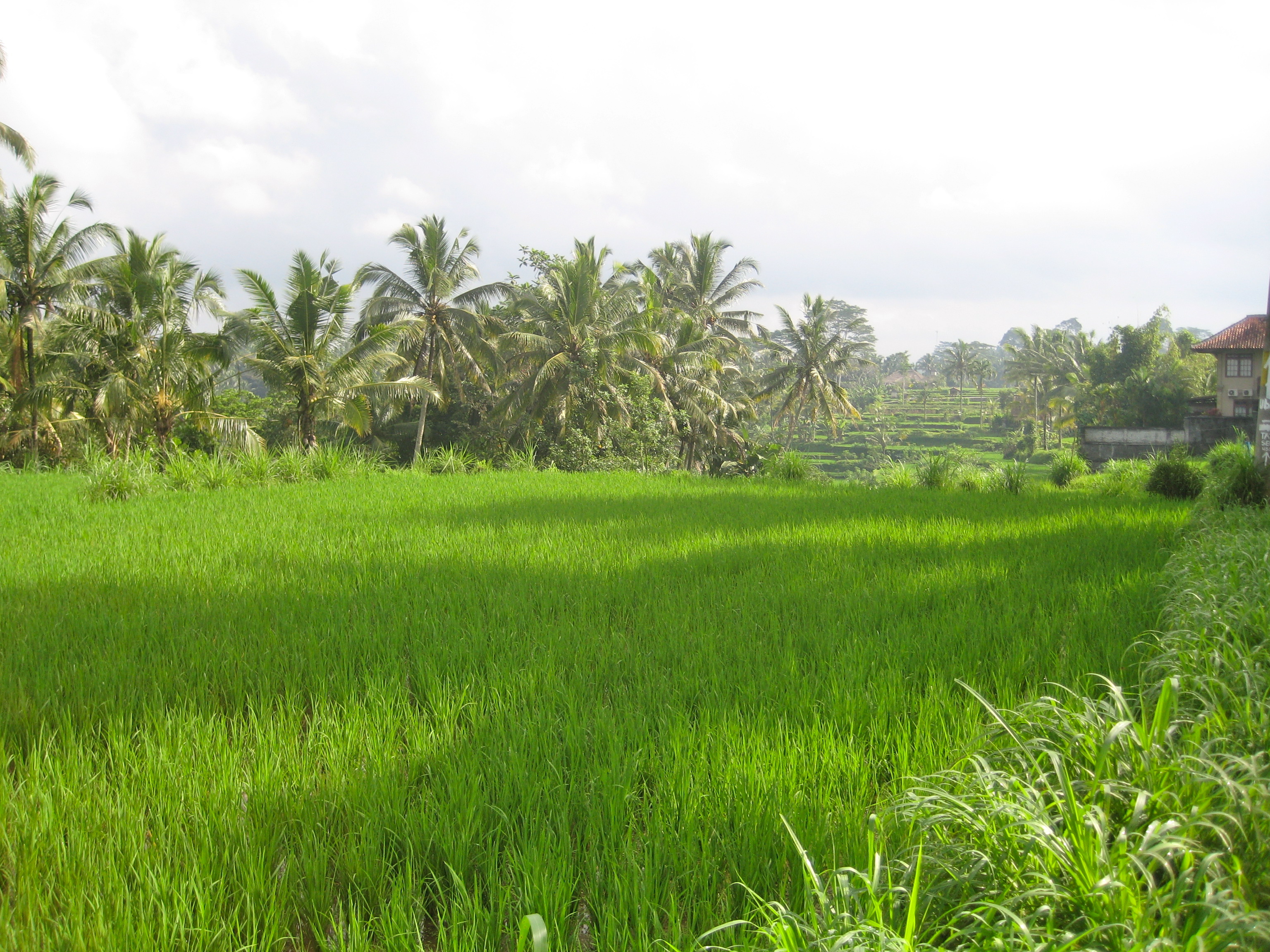
I’ve returned home from the green serenity of Bali to learn that while I was away, Tony Judt died.  The news was dispiriting, as though a lifeline had been broken.  I wonder if you may have felt it, too.  Following his lucid articles in the New York Review of Books which chronicled his year with ALS, sharing his latest book with you on Father’s Day, taking heart from his ability to work through the late stages of his illness — all this provided a sort of larger theater in which I could imagine your writing and perseverance finding a stage.  He gave me hope.  That an intellectual brilliance could still escape through the cracks of a walled-in body.  That ALS could tame his hands but not his mind.  That his days continued to turn over stones worthy of his curiosity.

Did he know, I wonder, that he was a comrade to all of us who sheltered in his light?  Probably not.  It was not his writing, exactly, that illuminated my world, but his courage in living honestly and rather boldly to the last; of thinking expansively in such cramped quarters – even when immobile, mute.  The force of inquiry, intellectual edge, personal vigor, the imperative to create – this is what inspired me about him.

And about you.  Without your even knowing, you continue to surprise and amaze me.  How your mind stretches like the blazing sun against the gathering night, reaching depth and tone and colors not seen in the noon hours of your career.  How your daily rising to the desk, early and strong, reveals a fierce force of will bent on articulating your life in the grammar of meaning.  Whether you finish your book or not is no longer the point – not for me, anyway.  The point is your living, which seems to say even without your trying, that you intend to conclude your life with the same solar power that energized it from the start.  That you care to think clearly, to edit judiciously, to act consciously, and to love generously through every diminution of your powers.  In my eyes, this is the effulgence of your days.

So, I wanted to take a moment to give thanks for the brave tenacity of Tony Judt, a comrade in the night, whose work was undoubtably unfinished but whose life was complete.  And to give thanks, as I do over and over again, for you, for the practice you keep of living deliberately, thoughtfully, and with bright resolve, which is a gift, more than any single book, that will live and grow in those who love you, forever.

Yours always,

Susan

A.Late(summer).Sweetness

•08/17/2010 • 2 Comments

From blossoms comes

this brown paper bag of peaches

we bought from the box

at the bend in the road where we turned toward

signs painted Peaches.

~~~

From laden boughs, from hands,

from sweet fellowship in the bins,

comes nectar at the roadside, succulent

peaches, devour dusty skin and all,

comes the familiar dust of summer, dust we eat.

~~~

O to take what we  love inside,

to carry within us an orchard, to eat

not only the skin, but the  shade,

not only the sugar, but the days, to hold

the fruit in our hands, adore it, then bite into

the  round jubilance of peach.

~~~

There are days we live

as if death were nowhere

in the  background: from joy

to joy, from wing to wing

from blossom to blossom to

impossible blossom, to sweet impossible blossom.

“From Blossoms” by Li-Young Lee

articulacy:language’s.substitute?

•08/15/2010 • 1 Comment

Historian, author, and teacher Tony Judt died a week ago. On July 15, less than a month before his death, he published an essay titled Words in the New York Review of Books. Words were Judt’s lifeblood, his “thing.” He was an intellectual — language his currency,  and he was a wealthy man. He knew the power of words, both to bridge distances and to fend off intimacy, to enlighten and to deceive. He wrote about the political and cultural dangers when words lose their integrity, and about his personal dread of words losing their speaker, their originator, which is to say, when in the final stages of ALS he would lose his world of words.
This is the beginning of my mother’s journey. Words are the first to go. Actually, they haven’t gone. They’re still there, in her head, on her unmoving tongue, unable to be released to dance in the space between us.  Silence is now filled with hand gestures and scribbled notes. At the doctor’s office or when friends stop by, I play interpreter.  Looking for ways to articulate all she needs, and all I want, to say.

Afloat.Lilies.Searching

•08/06/2010 • 2 Comments

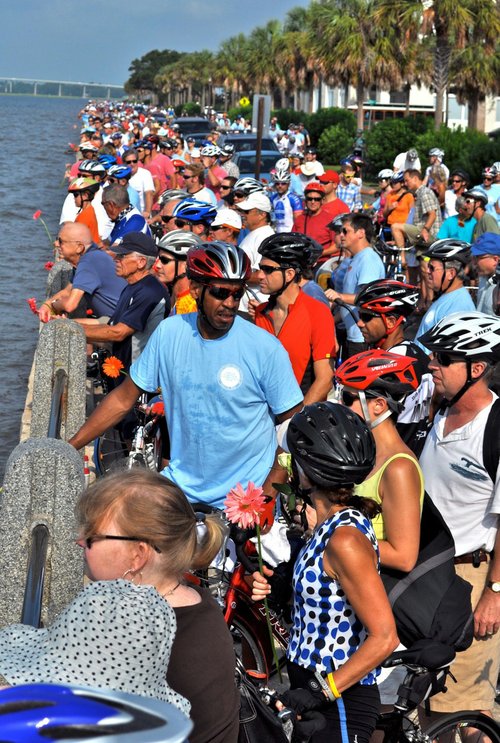
We gathered early last Saturday at the site of old museum ruins. First maybe 70 of us, then 100, before long 500. We rolled down the stately streets of Charleston on various versions of two wheels — some on tricked out carbon-frame Treks, others on garage-dusty clunkers, the wee ones on training wheels.  Actually, we all wobbled on training wheels, as we tried to find balance on the hard pavement of grief.  We rode in mourning, and in celebration, and in our wake, silence.  No rattle-hum of car engines, no whizzing by of SUVs. The streets were ours, and Edwin’s, for a short 2 mile jaunt on a steamy weekend morning. When we met up with the rowers out on the water, bidding their shipmate a traditional mariner’s farewell, we tossed lilies and gerber daisies on the harbor. A floating bouquet that stretched the length of the Battery. I’ve never seen anything like it.

Since Susan’s last post, our friend Edwin’s life, cut tragically short, has been celebrated as poignantly and exuberantly as he lived. At the other end of the longevity spectrum, her mother-in-law took a nap, as is a 93 year-old’s privilege, and kept sleeping. As graceful a passage as one can hope to make.

And so we toss lilies into the harbor. We remember. Around the corner, the school year starts to rev up, cranking its own engine of routines and obligations.  Our computers and calendars emerge from summer “sleep mode.” We get busy. And somewhere, flowers drift lazily on the tides, searching for safe harbors, welcoming shores.

attending.love’s.suffering.

•07/30/2010 • Leave a Comment

The red circle growing around the newly installed feeding tube is troubling, painful. An infection mounts.  The procedure must be done again – this prosaic short cut to the stomach – for the day when my father’s tongue and throat give out.  I absorb the suppurating details miles away on the phone, and try to let the pain of it pool around me, to hold a portion of it for a while.

A few blocks away, my mother-in-law suffers a black, festering wound that will not heal.  Her 94 year old frame cannot circulate blood enough to mend it; nor survive the surgery to repair it.  She will not complain, nor speak of it at all.  But her eyes weaken, lost to the night.  I look into them, as I can; I try to not look away.

This morning, a friend is bereft beyond speaking.  Her husband has been shattered by a SUV while steering his way home on a bike. Her child, now, is fatherless, and young.  I open the door to their burning grief, and let it roar in the chambers of my heart.

If I am to attend to those I love, then I must enlarge myself in order to hold all of their life and its many mansions — even the empty rooms, even its corridors of harrowing pain .  I must let my heart break, over and over, a little or a lot, but every time; in order to hold the love that also rushes in.  I must learn to stay still, quiet even, when I can do nothing but breathe with the other whose life is on fire.  And to bear it.  To bear the beams of love and the long chill of fear.  Together, to bear it all together in the house of my heart, made larger each day by those who have taken up residence there.

Susan

Approaching.Limits(of).Safety

•07/25/2010 • 2 Comments


“Be safe. Be so, so safe,” my 10 year old Claire says every time I walk out the door. Her postcards from summer camp ended with that same mantra, scribbled in large emphatic letters. During the school year, it’s what she yells over her shoulder every morning as she bikes down our lane, headed toward roads and school hallways filled with more danger than I’ll face, back inside with my coffee and chores, but she admonishes me nonetheless. “You be safe,” is both her wish and her command, as if she’s the parent guarding her vulnerable brood.

As I left my mother’s house this week, after five days spent helping her recover from pneumonia, I channeled Claire. “Mom, if you eat, be safe,” I said in my best stern-but-loving tone. Aspirating food or saliva landed her in the hospital, gasping for breath. Her swallowing is unruly, she chokes easily; eating is no longer safe. And yet she is fiesty, and loves Breyers Heath Bar Crunch, and who am I to say You May Never Taste That Goodness Again.

I arrived home to news that a friend had been in a horrible bike accident. A long day and a half later he died from his  injuries. Disbelief, heavy sorrow, anger and fear swirl in my heart and head. Edwin was a gem. Passionate, purposeful, funny, brilliant. Like Edwin, I am a cyclist. A careful one, as he was– both in terms of safety, and in terms of why we ride–full of care.  We ride out of care for the earth, our bodies, the sense of community that traveling on 2 wheels, at eye level with fellow passers by, can nurture. But when drivers — isolated in their own domain, their own speedy world — are careless, there’s no way to be safe. One can only be lucky, or not.

I went out this morning for a two hour bike ride, clinching the slim white line on the road’s shoulder like it was an endless strand of prayer beads.  Safety is elusive; risk ever present. I swallow hard, pedal hard, pray harder. And yes, sweet Claire, I’ll do my best to be safe.

august.last.summer.(08)

•07/15/2010 • Leave a Comment

I am wanting to go back to the time before Stephanie and I started this blog and remember those first stunned moments before ALS was an acronym that I dropped comfortably in conversation, before I had shaped myself around its reality.

This is a journal entry written after my first visit to my parents in August, 2008, just three days after learning of my father’s diagnosis.

. . . . .

When the phone call came, I thought a bottle had shattered in my chest.  My spirit as a vapor rose; it swirled above my body, unmoored.  I couldn’t move; yet everything was moving.  A vertigo of spirit swelled out from this strange new altitude of grief.

The only thing I wanted was to go and put my feet at the axis of the turning, to touch the flesh of my father now sick beyond healing – only his hand could, in its trembling, its reality, anchor me again — though to a different world now altogether.

Mother.  Father.  Brother.  Sister.  We pulled up under the shade of sweet gum trees for sandwiches, our faces freshly peeled, and tilted our heads  toward one another, as we always have.  In this momentary lowering of the brain and brow and its bowl full of selfishness, we are quietly emptied so that we might then receive the meal before us.  Around the metal porch table, over paper napkins and soda cans, hands crawled from our laps and met in the simple circle that was our beginning – our humble quaternary – and our heads, low, emptied, leaking out, now waited for the first time for some new blessing from the deep.

My father’s voice was rounder, softer, echoing up from the bottom of a well, as he achingly named those present and not present and poured blessing upon each one – bent over, even now, in gratitude.  Even now, as though, especially now.  His voice brought up waters from a bottom I have not yet reached; words wet with life, darkened with death.  Looking up, I saw the noon light brushing the back side of falling leaves; I saw small rivers wash my brother’s face.  He looked at me intently, but without question.  I looked back without answer.  We are here, now.  That is all.  We are together in this new place, out beyond any knowing, under a strange new sky.  There is no where else to go.

Then we took the bread and meat.  In the warm breeze, we broke, we ate.

Susan

Adolphus.(L.)Stone

•06/26/2010 • 3 Comments

Stone lets himself in the front door early in the morning.  He flows into a well-developed routine, grooming my father for the day — lacing his shoes, combing his hair, setting out pills, adding or subtracting his glasses.  After my father has made an exhausting trip across the board which bridges wheelchair and bed, Stone clasps him with a gentlemanly, affectionate pat; one that says  I’m here. To the end.  Whatever it takes.  I’ve got your back.

Stone moves silently through the chores of living.  There is no chatter to take an edge off awkwardness.  Only a side by side ease of presence between them that time has built.  The man caring for my father as he loses his voice has already lost his own.

Adolphus is his elegant given name, and it suits him well.  But Stone is the name by which people know him – for indeed his face is chiseled, is stoic and silent, contained and timeless – until, that is, it breaks open into a grin and light gushes forth as water from a stone.

It may be that his military experience prepared him for the orderliness my father demands.  Or his days as a chef prepared him to arrange the occasional meal.  But it’s his to-the-mat battle with throat cancer that has made him a rock-solid care-giver.  Having fought for his life, months on end, through the cruelty of chemo, he came out of it mercifully alive, but without the sound of his own voice.  Like Jacob who fought all night with a dark angel and lived, though with a limp.  Like all of us who face our demons and emerge, marked for life.

Stone knows the deep trenches where my father finds himself.  Words are not really needed there.  More important is the presence of a fellow soldier who has got your back.  One day, they will both be silent; all words trickled out.  There will be nothing else to say.   And yet, and yet . . . this silence, held between them, strong as stone itself.

Susan

Ace.Lob.Smash

•06/22/2010 • Leave a Comment

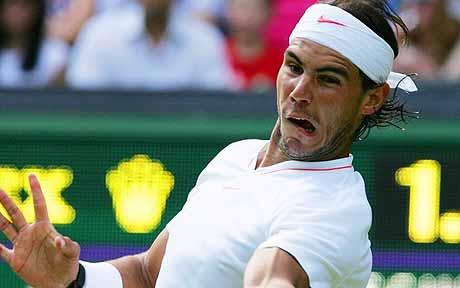
For most of us, the four seasons are Spring, Summer, Winter, Fall. For my mom they are the Australian, the French, Wimbledon and the US Open. Watching tennis is her passion– and when hunky Nadal or the ever-focused Federer are on the court, it’s easy to see why.  Mom’s calendar is set by the majors; and when ESPN offers coverage, she’s tuned in. Just 20 feet from the TV, her antique aluminum Wilson T-2000 sits in the coat closet, but it hasn’t seen action in 35 years. It’s a relic of days gone by, the days of Chrissie and Billie Jean, long before Venus and Serena were even born, back when polyester halter-top tennis dresses and matching Tretorns were all the rage.

Playing tennis is an inheritance from both my parents, one of the things they gave me jointly, before their divorce. I learned to play by watching them play, then hitting balls with them as they wound down after a match.  My  older sister and I competed on the junior circuit, traveling to tournaments in small towns across North Carolina. I rarely won trophies, or progressed much past the 3rd round, but I loved the game nonetheless. I still do. And though she hasn’t hit a ball in a quarter of a century, my mom is a tennis junkie, and Wimbledon–with its strawberries and cream and John McEnroe’s annoying repetition of the word “fortnight”–is her fix.

As Rafael and Roger grunt and ace their way through the brackets, mom and I will chat about the day’s matches. She’ll add commentary on the Williams’ sisters wardrobe, and update me on who’s who in the impossible-to-pronounce women’s line up. Then we’ll sit and watch the ball go back and forth; we’ll observe athletes moving with unfathomable power and precision, and think back to the days when, we, too, knew the muscular satisfaction of  placing a ball deep in the cross court corner, of passing our opponent with a down-the-line service return. The days when our bodies responded to our brain’s commands, and balls danced off our rackets and across the net like sweet yellow promises.

Stephanie (aka Steffie)

alabama.license.sticks.

•06/11/2010 • 2 Comments

The car takes the road like butter on hot toast.  Melting over speed bumps, smoothing around sharp curves, floating across our several bridges, aloft.  The seats are air-conditioned cool and feel like menthol on my summer-sweaty back.  Van belts out his heart-aching lyrics from six surrounding speakers – croons and picks and drums me through traffic lights.  This is a magic mobile.  My father’s car, the one he can no longer pretzel himself into even with the help of two men.  Now he motors up a ramp into a van, pivots, aligns, click-lock-shut goes the wheelchair; and he’s off with his grandson at the wheel, ramp door clanging over every crease in the pavement.

My husband and I have inherited the family jewels in the form of a luxury car – we who heretofore drove functional hybrids and beat-up Volvos.  Reading the car manual is better than fiction.  Really?  The back seat arm rest is really a beer cooler? The rear-view sun shade automatically withdraws itself without being told whenever I back up and then quietly resumes parasol position when I’m not looking.  The woman in the dashboard is always, inexplicably, right no matter how wrong I turn.    Did James Bond ever drive this car?  It’s that foreign and fascinating.

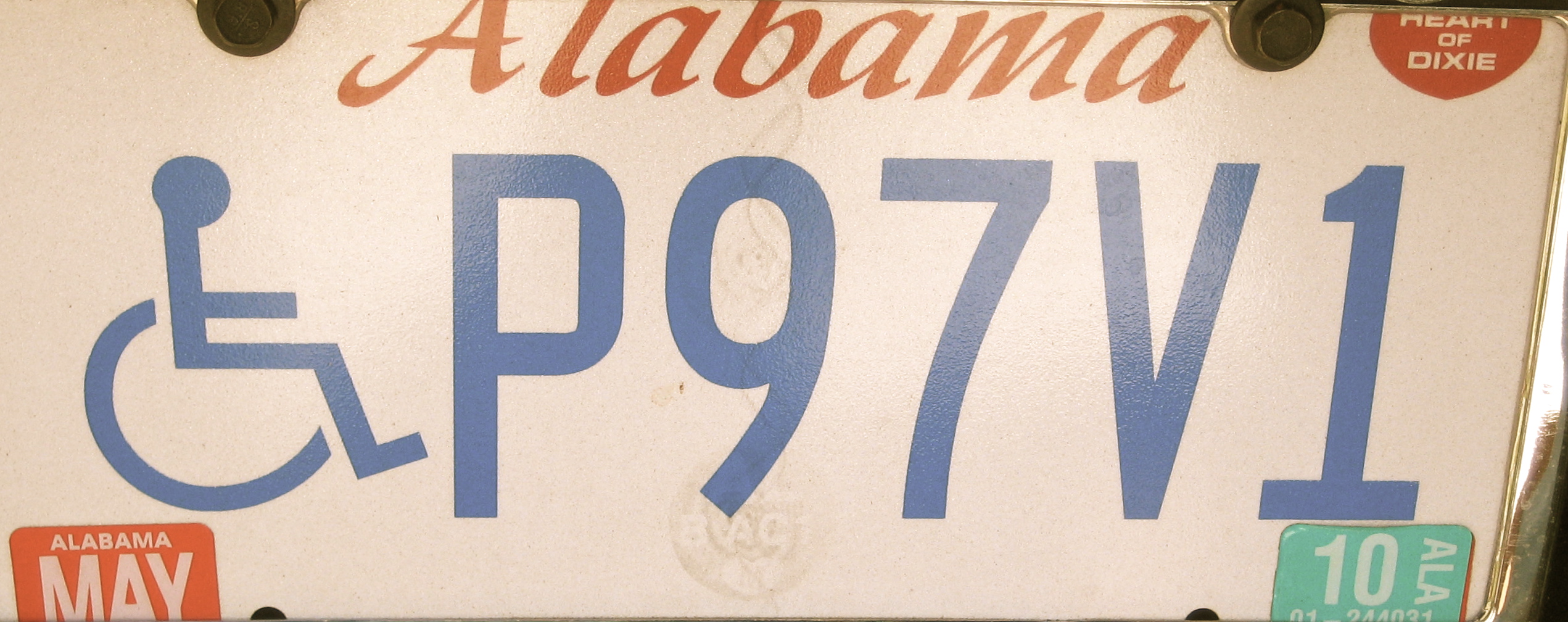
The Alabama disability tag on the rear reminds me that I’ve inherited not just the butter of life but also the dry toast.  Hard to swallow stuff.  It comes, always, as a package. Abundance and loss.  Comfort and consciousness.  Gratification and grief.  Even a smooth ride can come, anytime, to a crashing halt.

I live and move inside this reality now.  The car door recognizes me before I arrive, submissively unlocks itself and invites me in.  I touch the good life my father made for me and say thanks.  Behind me, I am tagged for life. Long after a healthy South Carolina tag replaces this one, I will still know all too well the ways I am disabled.  The things I have lost.  The sadness in the deep pockets of things.

Susan