
This
Sky
Where we live
Is no place to lose your wings
So love, love
Love.
Hafiz
from The Gift, poems by Hafiz
translated by Daniel Ladinsky
happy valentine’s day 2012

This
Sky
Where we live
Is no place to lose your wings
So love, love
Love.
Hafiz
from The Gift, poems by Hafiz
translated by Daniel Ladinsky
happy valentine’s day 2012

All week long I thought her birthday was tomorrow — Sunday. I was caught off guard this morning when I saw the newspaper’s date: February 4. My mother would have been 77, such a sleek and elegant numeral.
Her shadow was cast long and lean over the day. It fell against bright February sunshine this morning, so warm it felt like May. It followed me as I walked my dog down to the Pitt Street Bridge, where we stood and watched silver shards of mid-morning light ignite the outgoing tide. It was there as I watched a small crowd of eight mergansers, the boys in their dapper headwear, moseying up the creek as a white heron shepherded them along. There’s something about shorebirds that reminds me of her — their patience, their sharp determination, their fine-featheredness, their solitude.
This may have been the week of Groundhog Day, but it was I who saw the shadow, the silhouette. Everywhere. And found comfort in it…a sense that the grayness of wintery grief is lifting. That spring might blossom, might open its wings, lift its beak, and carry on.
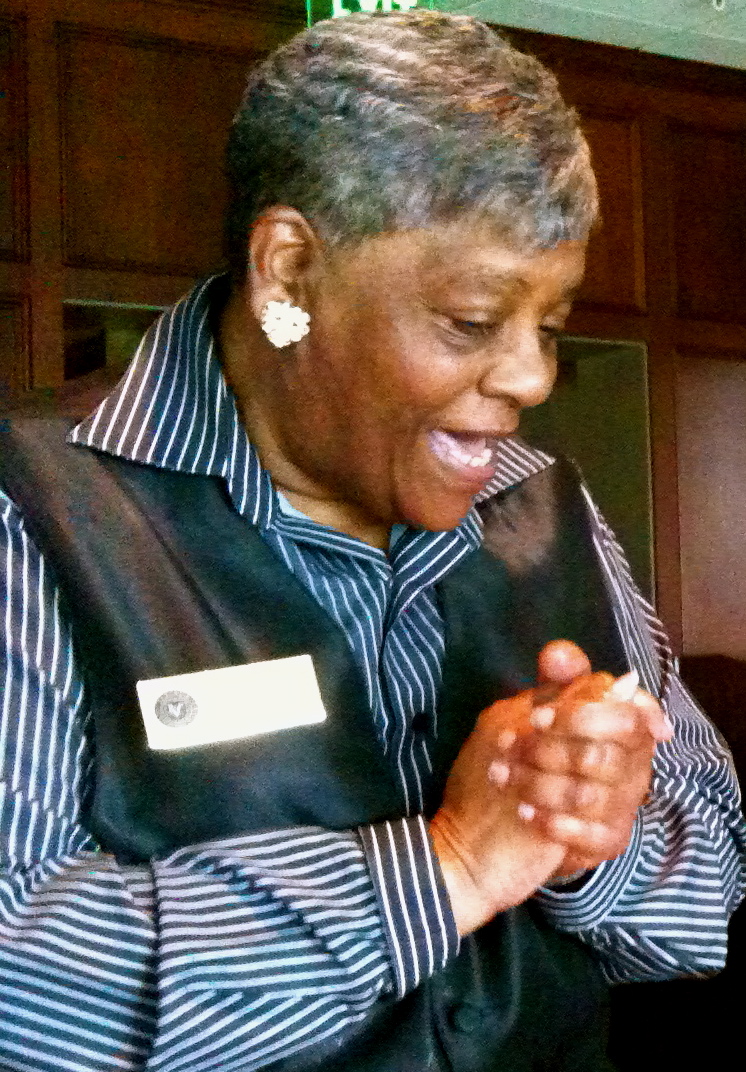
Barbara sets the lunch table every Sunday, removing one chair to create a landing pad for my father’s wheelchair, nestling the season’s cut flowers in the midst of complicated glassware, and then arrives with two tall glasses of fresh iced tea for my nephew, Andrew, as soon as he appears at the door following church. The Vestavia Country Club is easily navigable, and stays on my parent’s weekly schedule partly because of people like Barbara and the head valet and all who care about my father in small, important ways.
On Christmas Eve, Barbara welcomes seven of us to lunch. She arrives grinning with the two iced teas, warms our plates for the buffet, slips my mother a wrapped gift – a pearled hook to hold her purse at the dining table. I’m tired of seeing your pocketbook on the floor! she fusses.
Just before we leave, beginning our round of Christmas salutations, Barbara quietly announces her departure from the club. She has her own health issues, it seems, that prevent her from returning to her post in the new year. My mother is crestfallen – quickly exchanging phone numbers for staying in touch, and insists a picture be made together. Around us, the room swirls with the pander of a bulbous Santa Claus, bright holiday sweaters, children balancing plates of cookies, and the clinking of all that glassware. Barbara leans down to my father’s cheek and holds hers against it. She reaches her arms, as much as anyone can, around his shoulders, offering a last good-bye. Their silence holds everything.
As my father wheels into the van, the valet slips packages of meats and sweets under the seat – Barbara’s parting benediction. An underground river of compassion, flowing from deep unto deep.
I scoot into the back of their bumpy van, thinking of those who really count, in the end. The ones who show up, over and over, and carry the story with you. I think about how little everything else matters, except that which moved through Barbara’s hands. The dailiness of love.
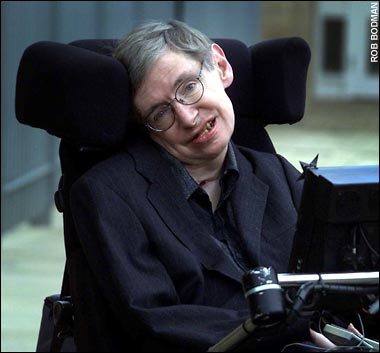
While still an undergraduate at Cambridge University, he fell twice, for no apparent reason. At 22, an unpromising, half-hearted doctoral student, he was diagnosed with ALS and given two years to live.
Something happened then to Stephen Hawking. He woke up, as from a half-lived life. He married and fathered three children, got serious about black holes and discovered some pretty major things about them (that they can leak energy and gradually fade away into nothing – that was a Einstein kind of breakthough), proposed a model of the universe which has no boundaries in space and time, and wrote A Brief History of Time, selling over 10 million copies worldwide. Along the way, he married a second time, dominated his field of scientific research for four decades, appeared as a bit of a celeb on The Simpsons, Star Trek, and a Pink Floyd album, and lived to see, this week, his 70th birthday celebrated by a gathering of world-class, adulatory scientists.
The disease, over its 48 year course, has taken his legs, arms, trunk; his chance of swallowing, even breathing normally. He is force fed. He can no longer speak. Three caregivers work in shifts to attend to his basic needs.
And yet, his mind, surging beyond that withering flesh, travels in orbits more spacious than most of us can imagine. At a gathering in December, he was asked what he is working on now. Long pause. Fiddling with his computer equipment, he finally eked out the six words allotted each minute by his robotic voice generator. The origins of the universe. At the same time, he worries about the path of destruction we’ve charted on the earth and pleads with politicians to colonize other planets. With so vast a reach of mind, Stephen Hawking lives in a super-sized vision of reality, once calling planet earth, endearingly, our mote of dust suspended in a sunbeam.
Over Christmas, I gave my father another tour of his ipad2. He was bent on finding a particular New York Times editorial that scratched his mind, that fed a thought he’d been thinking. He announced in garbled tongue that his latest book was coming out in March, and that he is halfway through the next one. My mother worries when she finds him hunched over his wheelchair tray, pressing the weight of his body into a slowly scrawling pen for hours. But I see a mind surging, expanding into a larger and larger reality, even as his body leaks energy, like a black hole, slowly fading into nothing. I see his thoughts ablaze in another realm where the body drops away. I see his energies gather and rise, like a mote of dust suspended in a sunbeam.

On this rainy day in the darkest week of the year, I find this poem sheltering. Last Christmas, I shared another G.K. Chesterton poem here which long has been in my family’s collective and ritual memory. Now this one I offer, hoping that we may follow the feet where all souls meet, At the inn at the end of the world. May you be surprised at what you find there; there where the dark is alive with rain.
There is heard a hymn when the panes are dim,
And never before or again,
When the nights are strong with a darkness long,
And the dark is alive with rain.
Never we know but in sleet and in snow,
The place where the great fires are,
That the midst of the earth is a raging mirth
And the heart of the earth a star.
And at night we win to the ancient inn
Where the child in the frost is furled,
We follow the feet where all souls meet
At the inn at the end of the world.
The gods lie dead where the leaves lie red,
For the flame of the sun is flown,
The gods lie cold where the leaves lie gold,
And a Child comes forth alone.
G.K. Chesterton
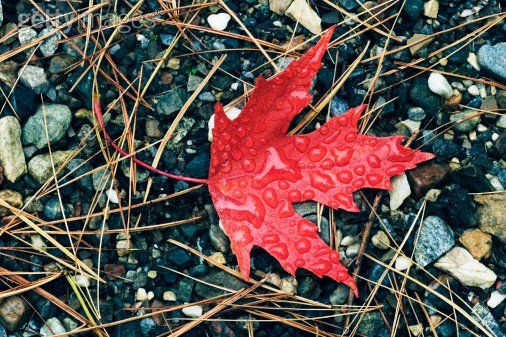

This photo by my friend Steven Hyatt just landed in my inbox, solving the question of what image to accompany the post that I’ve been percolating today. My post was tentatively going to be titled “Achy.Little.Salutes” — but in flew the seagulls, and out flew the title.
The “salutes” I wanted to write about are the sometimes small and often not-so-small flutters of sadness that catch me off guard frequently these days. Emotions that I need to salute, to acknowledge, and then I march on with my duties, my day. Grief is a Salvation Army bell-ringer who’s there constantly jangling in the periphery — a clanging reminder, a nudge that can lift my spirits or tweak my conscience, depending on whether I toss in a coin or walk quickly past, loaded down with purchases and guilt. Grief is the blinding flashbulb flash of Christmases past — of what we were doing this time last year, of ordering a sweater that Mom had picked out and wondering if she’d ever get to wear it, of remembering dear Lynn Brooks wrapping gifts that my mother had bought for us and numbering the boxes (#14, Black Turtleneck, youth medium) so the “To” mystery could (hilariously) be solved once Mom got out of the hospital after a pre-Christmas pneumonia scare — fleeting moments that flare up and leave dark spots in your vision. Grief is a gull that soars gracefully overhead, then swoops in, squawking haggling for crumbs and tidbits of whatever memory I was savoring.
Grief, like the gulls scavenging on our Charleston beaches, seems ever present this season, and it is hardly mine alone. At church yesterday, the choir’s acapella anthem totally undid me. At last night’s Christmas Parade, amidst the cheesy lights and chilly wind (and no fewer than 4 confederate flags in the mix), boy scouts marched behind their float, but all I could see were the rows and rows of uniformed scouts who packed the choir pews at Stuart’s funeral. We pull out our decorations from the attic and I think of Andrea and the kids hanging ornaments, how the glittery balls must droop more heavily on the tree this year, and I bow to the ache again. I think of two Leslies in High Point feeling deep loss amidst the merriment, I think of my friend Suzy whose mother died right before Thanksgiving, of my cousin Bill who made beeswax candles for our church’s Christmas Eve service this year and will light his own candle on the 24th without his wife Ann. Beyond my circle, there’s Joan Didion slouching through her blue nights and Dominique Browning, who recently wrote so piercingly about this same topic here….
Yes, the gulls are flocking, lots of them. They dive and dip into the waves; they land and tuck-in their wings; they circle overhead blending in with winter’s dirty gray sky. They laugh in the wind. They fly away.
The critical thing is whether you take things for granted or take them with gratitude.
G.K. Chesterton
In Mary Oliver’s Gratitude, the poem trickles from the gentle prod of simple questions. Most of her stanzas, her answers, are longer than I have included here, but the questions are the real feast she offers and what I most wanted to share. An eight-course meal, for Thanksgiving. May your own answers be equally delicious.
What did you notice?
The dew-snail;
the low-flying sparrow;
the bat, on the wind, in the dark…
What did you hear?
The thrush greeting the morning;
the little bluebirds in their hot box;
the salty talk of the wren,
then the deep cup of the hour of silence.
What did you admire?
The oaks, letting down their dark and hairy fruit;
the carrot, rising in its elongated waist;
the onion, sheet after sheet, curved inward to the
pale green wand….
What astonished you?
The swallows making their dip and turn over the water.
What would you like to see again?
My dog: her energy and exuberance, her willingness…
What was most tender?
Queen Anne’s lace, with its parsnip root…
What was most wonderful?
The sea, and its wide shoulders;
the sea and its triangles;
the sea lying back on its long athlete’s spine.
What did you think was happening?
The green breast of the hummingbird;
the eye of the pond;
the wet face of the lily…
so the gods shake us from our sleep.
excerpts from “Gratitude” by Mary Oliver, from What Do We Know
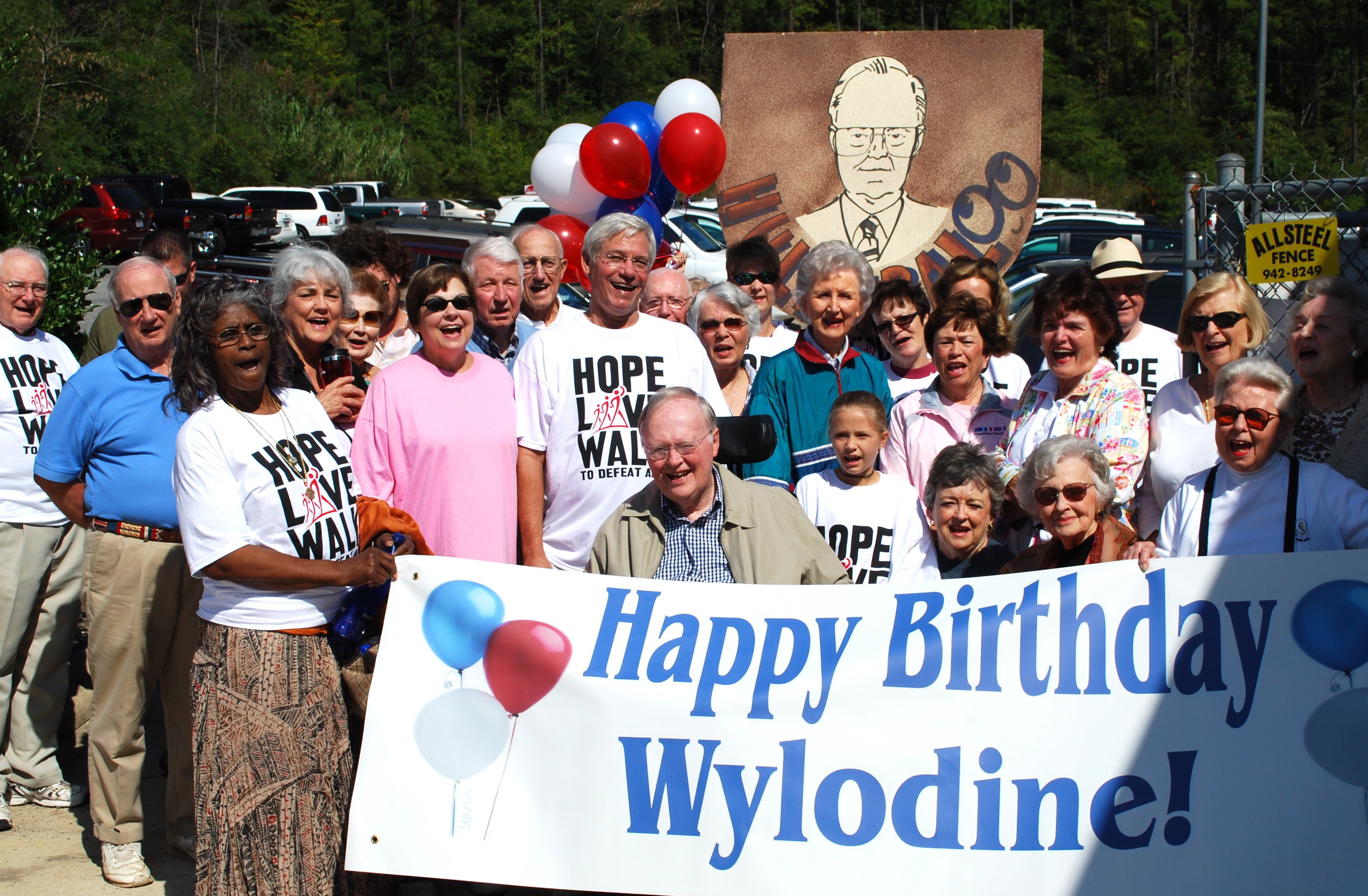 She doesn’t like surprises, I warned my nephew; but Andrew had a vision for his grandmother’s birthday and is not easily deterred. So, on a bright Saturday morning in October, I find myself huddling with a crowd at the Vestavia Hills High School football field under the beneficent sun. There is a professor of theology sporting a baseball cap; robust seniors from the church shimmying into T-shirts. There are the handsome young neighbors with little Andrew and Luke who come sing How Great Thou Art for Mr. Bill, and dip hungry hands into my mother’s bowl of green apples. Then I spot Laurie, the hospice nurse who is showing up on her day off. And off-duty caregiver, Marilla, too, wanted to come. Now I see the contractor who has taken care of my parent’s house for 25 years, down to putting in a wheelchair lift and constructing an accessible bathroom. Friends who share their home-made, lip smacking BBQ and custard pies are grinning and game. There is my beautiful niece and her new husband, who drove from Louisville into the night to polish off the surprise. Darting through the crowd is a young girl I do not know, but who has an affair of some great affection going with my father, and wonders how soon he will arrive. I see a close ally whose husband was lightning struck with a heart attack not long ago, taking one my father’s dearest friends. The pastor, newly retired, has not forgotten his colleague. It is a small crowd growing quickly into a kinesthetic congregation.
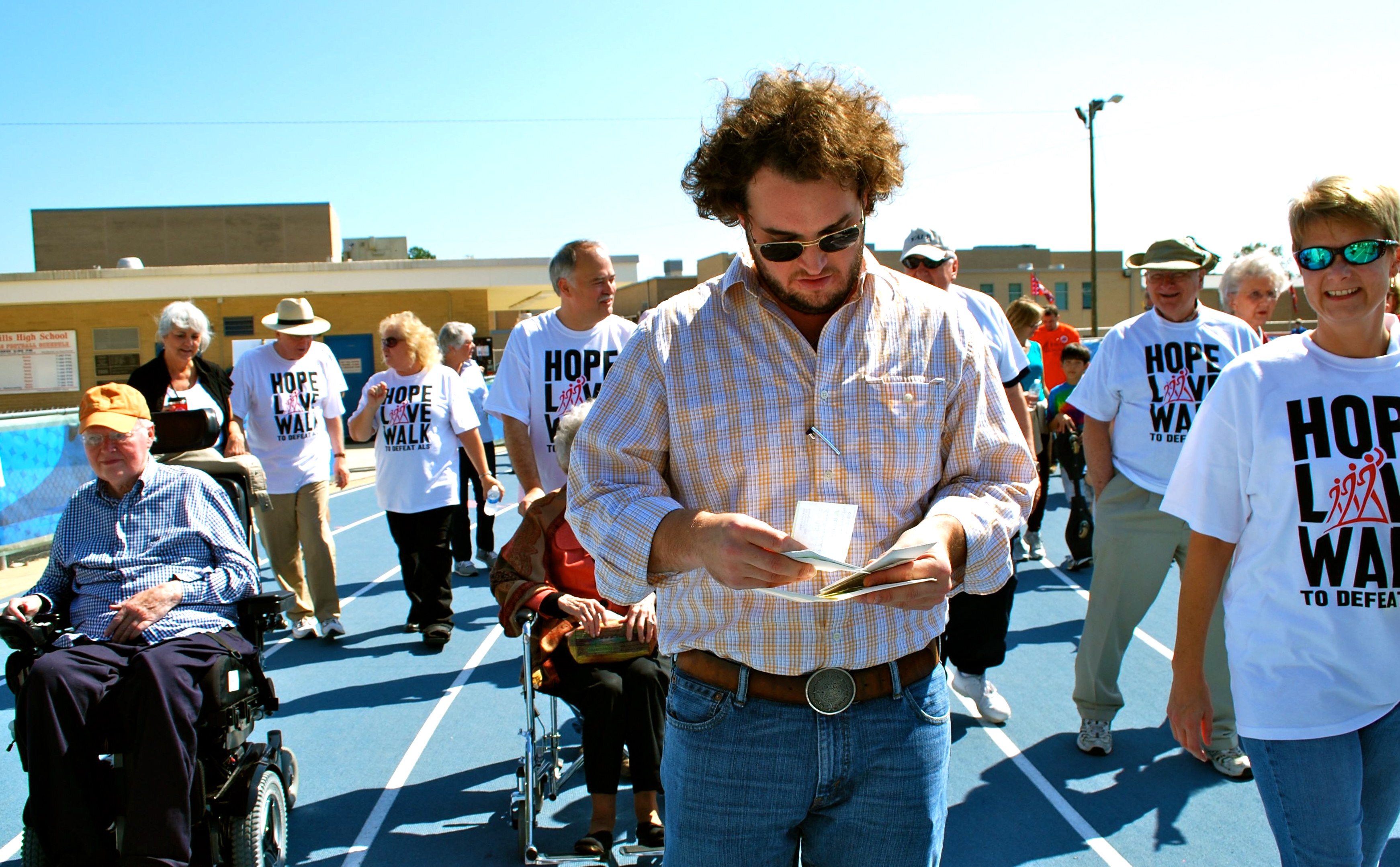
Around our huddle, a larger crowd streams in. Wheelchairs are common, and those in them uncommonly still; friends navigating their passage. It is the Alabama Walk for A.L.S.
As per plan, Andrew pulls up in a white van and disgorges two wheelchairs: one my father navigates down the slim ramp; the other is set up for my mother’s frail legs. They have no idea why they are here. I wheel her around to face the crowd of beaming faces, a large birthday banner draped in front of them, as they break into birthday song.
Well, she may not like surprises, but you wouldn’t know it now. My mother is lit up with this simple incandescent moment, the faces of her many friends, the sun warming her cold shoulders. Behind her my father rolls up, eyes twinkling with surprise, and they grasp hands, chair by chair, as the singing spontaneously slips into for he’s a jolly good fellow; the back row raises a caricature of his professorial face.
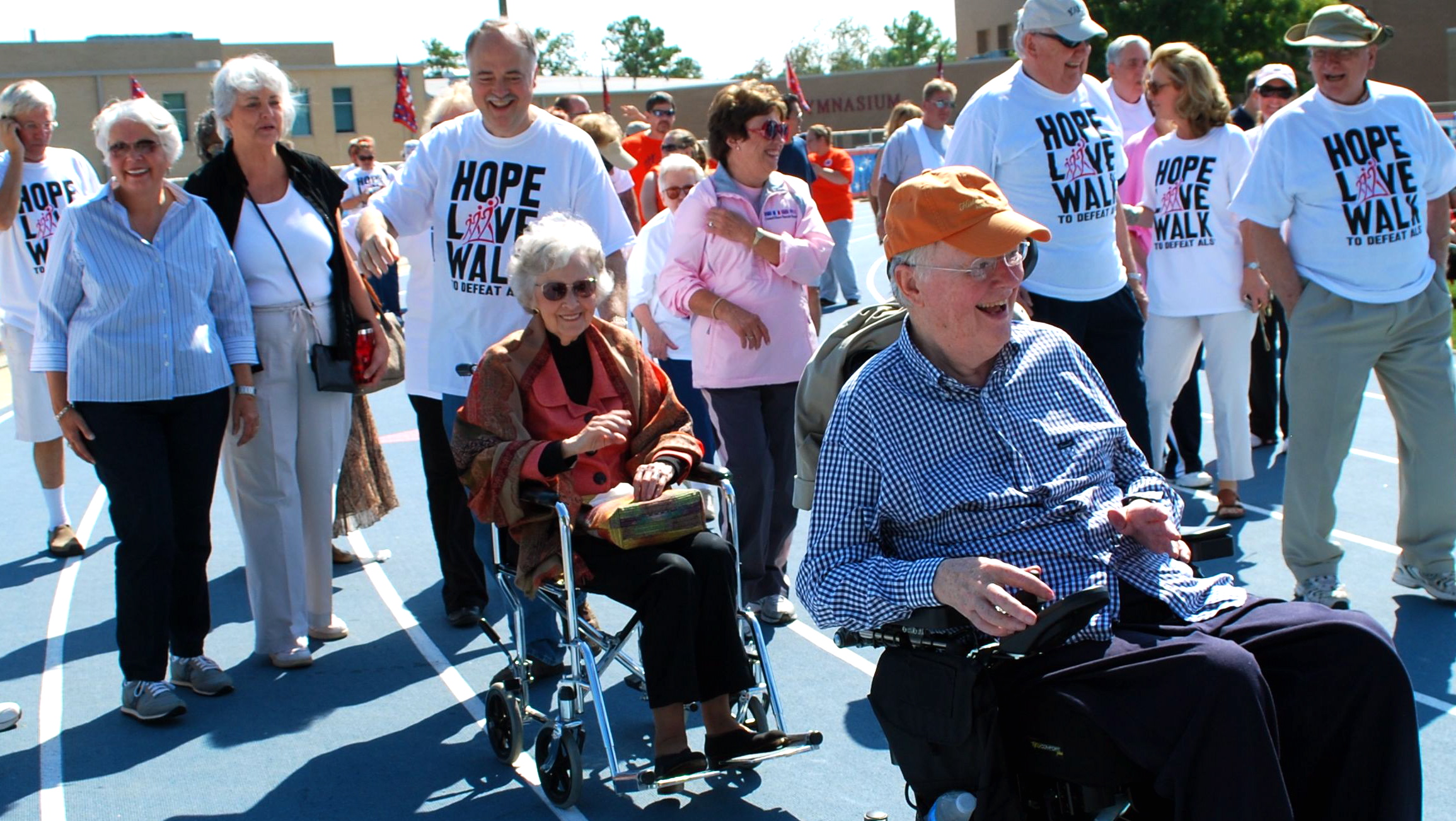
Then, we are off to the races. My father has never had the chance to break loose on his wheelchair; until now, that is. He zips along the track in speedster mode. My mother reigns from her birthday throne.
There is no competition here. No finish line. Only the family lunch back on the deck which Andrew has also orchestrated. The perfect vision of a day, conceived and manifest by a grandson who believed that surprises could be salubrious. Andrew raised $6500 for the ALS Foundation that day. And he invited all of us to exercise the muscles of love, once more around the track.
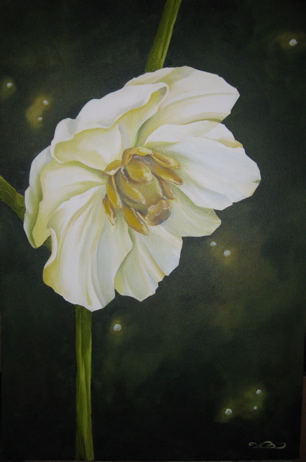
"May Apple" by Honor Marks*
Excerpts from “A Sister’s Eulogy” (do read the whole thing) by Mona Simpson, for her brother, Steve Jobs. The man who almost gave my mom her voice back, via the iPad. Almost.
Novelty was not Steve’s highest value. Beauty was.
His philosophy of aesthetics reminds me of a quote that went something like this: “Fashion is what seems beautiful now but looks ugly later; art can be ugly at first but it becomes beautiful later.”
Steve always aspired to make beautiful later.
He was willing to be misunderstood.
Love was his supreme virtue, his god of gods.
He believed that love happened all the time, everywhere. In that most important way, Steve was never ironic, never cynical, never pessimistic.
Steve cultivated whimsy.
He had surprises tucked in all his pockets.
He treasured happiness.
He tried. He always, always tried, and always with love at the core of that effort.
This is what I learned: he was working at this, too. Death didn’t happen to Steve, he achieved it.
But with that will, that work ethic, that strength, there was also…capacity for wonderment, the artist’s belief in the ideal, the still more beautiful later.
His final words:
OH WOW. OH WOW. OH WOW.
*The May Apple can be distinguished by its forked stem terminating in two large umbrella-like leaves. A single nodding flower blooms in the fork of the stem. Also called American Mandrake, the May Apple is a source of podophyllotoxin, a chemical used in the development of chemotherapy drugs.
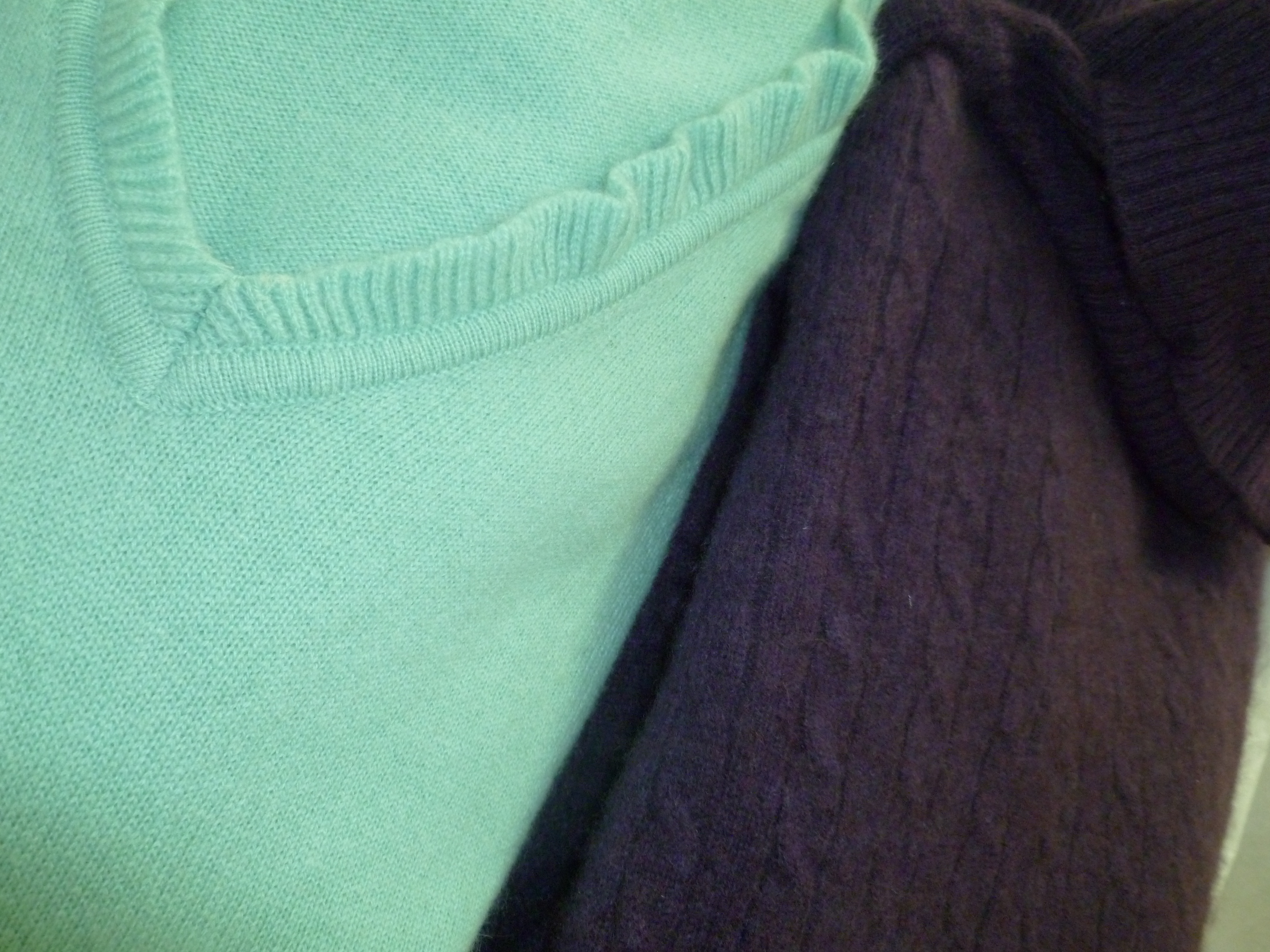
The cashmere is pillowy soft, like a clean furry puppy without the puppy smell. They get fluffy and soft from putting them in the washing machine — “Gentle Cycle” she tells me. So soft you want just to rub your hands over it, which Mom does as she folds them, just so. Sleeves turned back and tucked neatly underneath, then she bends the sweater over itself, as if it’s taking a bow, and lays it to rest in the plastic storage bin.
I wrote that last April, according to WordPress’s memory — the memo at the bottom of the screen says “Draft last saved at 9:51:28 am on 4/12/2011.” I had just come home from a spring weekend with Mom, and one of our chores was putting away her winter clothes. She was so weak it took her five minutes to fold each sweater, which she did, with precision and tender care. I knew as I watched her, and knew that she probably knew too, that she would never wear them again.
This past weekend my sisters and I convened in North Carolina and tackled mom’s house, cleaned out the garage storage room full of family antiquity, including her Aqua Net helmet-style hair dryer (see exhibit A, although Mom’s was white)  and a mini black-and-white television set with 1960s-era manual knobs and an antenna. From the guestroom closet we resurrected a yellowed debutante gown and various taffeta bridesmaid travesties, and, in a quiet moment, I pulled out the plastic sweater box that I knew was waiting for me.
The earth now begins its slow tilt away and the autumn air is turning frisky, temperatures are dropping. I fold myself in soft plum-colored cable-knit cashmere; I am warmed and comforted. I think about what we tuck away, and what we hold on to.
 Susan
Susan Stephanie
 A Still Life...A Life Still