afghans: lap shelter

•10/14/2011 • 1 Comment

Just as the family gathered around the dinner table to celebrate Mother’s 80th birthday, Marilla phoned.   My parent’s zesty caregiver had left the house an hour before, had driven the long road home, and had walked through the door just as her husband, ailing in bed, breathed his last.  No one had imagined this.  I held the phone, stricken with the quiet suddenness of death, while around me hummed the revelry given to a day of birth.

That was last year.

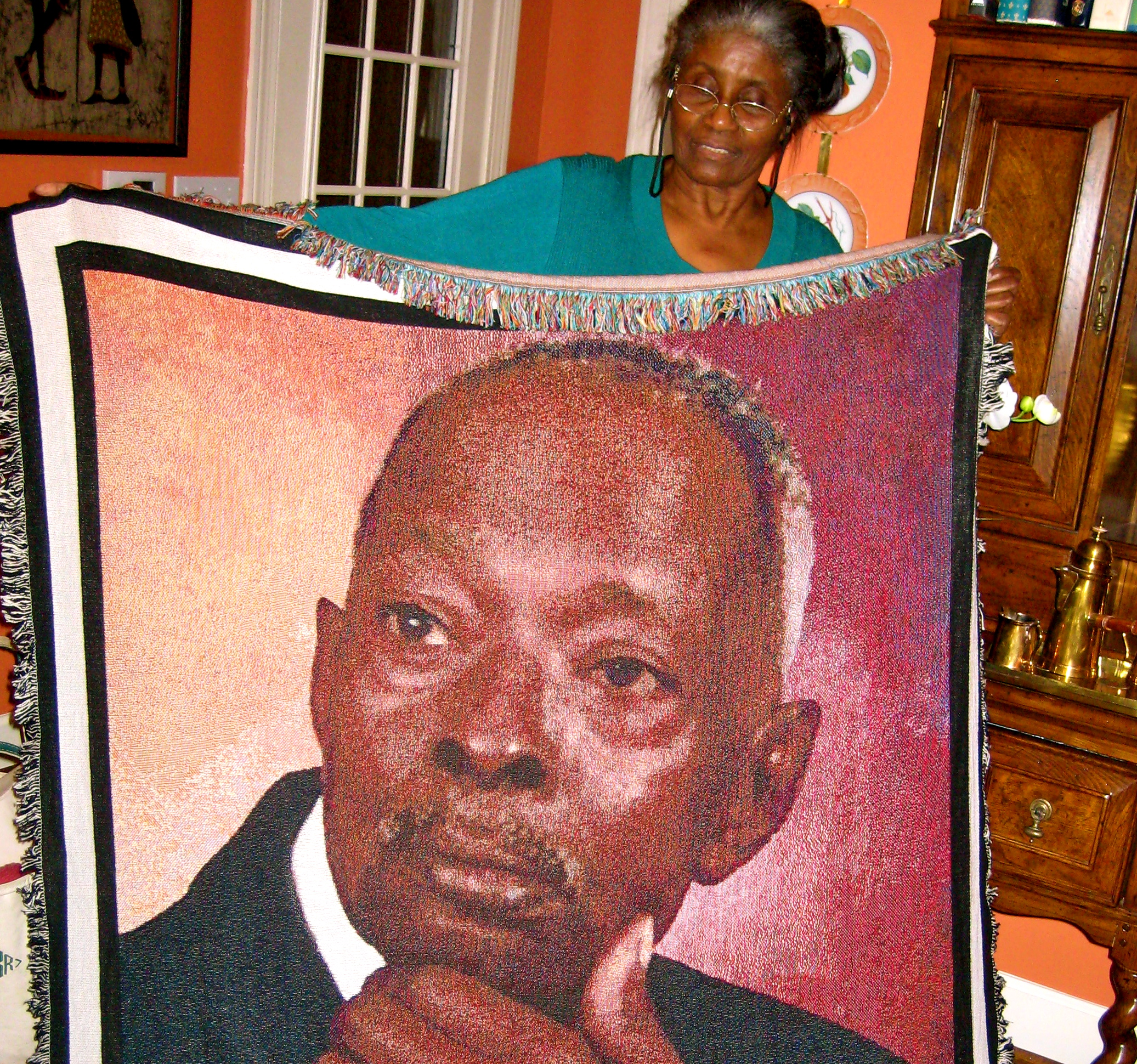
On my visits in the months since, I watched Marilla adjusting to life alone.  Her face is made for joy, her eyes for laughing; so that her grief eeked out slowly, reluctantly.  One day, she showed me a large comforting throw that she had ordered with Burpo’s image covering the whole of it, blanketing her as she falls asleep on her living room sofa, as she dreams him back into the empty night.

Between the tube feedings, extra loads of wash, the oxygen set-up, and washing the dishes, Marilla grabs a seat at my parent’s kitchen table and turns yarn into softly opening flowers – petals that drape over one’s cold legs or curl around a napping child.  She makes her own comforting throws, cooking up wild colorways with her crochet needles – bright blues and orange and exclamations of gold.  For her nine children, or twins at her church, or for sale to her admirers, needles click late into the night.

My mother joins her at the kitchen table.  They talk about grandchildren, the empty house, the tangled needs of the day.  They lean in toward one another, weathering the season, sheltering in the presence of the other.

This past Saturday, one year later, the family gathered for Mother’s birthday lunch around the table on the deck; Marilla now among us.  After platefuls of barbeque and slaw, Marilla fetched a gift bag bursting with deep purple and pink, wrapped in long ribbons of affection, and spread an afghan of her own making over my mother’s cold knees; which spread absolute delight across my mother’s face.

Going into winter, these two women wrap themselves in the comfort of threads and in the warmth of one another.  Knowing, as they do, the suddenness of change. The solace of the kitchen table. The sisterhood of birth and death.

A.Lined.Sky

•10/10/2011 • 3 Comments

They hammock overhead, stretch alongside our lives, crisscross our comings and goings, drape our days and fade into the lamp-lit night. To carry forth Susan’s current from her powerful “life electric” post, I’m struck by how complacent I have become to the complex landscape of electricity that webs our sky. I hardly notice it; I overlook the drab black wires, while depending thoroughly on the high-voltage they deliver.

Until, of course, SCE&G recently decided to “upgrade” the power lines along Coleman Boulevard, our town’s main street. Massive 95-foot tall towers of steel, like surreal cacti on steroids, began cropping up last spring, and now they tower over the boulevard, rising high above the tree-line, looming with an in-your-face industrial, utilitarian ugliness that infuriates me out each time I pass by. How could we have such disregard for natural beauty? For any sense of proportion? How long, I wondered, would it take until they, too, would just blend in with the landscape and I’d stop “seeing” them, the way I have more or less stopped seeing the wiry grid that has hung above me, linking my homes, my neighborhoods, powering my life, all along? The way I stop seeing piles of clutter around my house. The way whole days can slip by without me thinking about people who were once the wattage of my being, and now are gone.

It turns out that I’m not the only one incensed by the behemoth poles invading our quaint streetscape. Town Council responded to constituent grumbles by approaching SCE&G and asking them about “improving the appearance” — hoping maybe that a little touch-up paint might do the trick.  Actually, I’m not so sure that aesthetic improvement is possible, or the best plan. Maybe this daily visual assault will make me more aware of my voracious use of electricity, of the price of energy dependence, and more symbolically, of the Big Things that loom and cannot, should not, be overlooked.

ancient. loom. showing

•10/01/2011 • 1 Comment

We’ve gutted our bathroom.  It’s an old house, and peering under the floor boards may happen once a century.  Still, we were a little surprised to find, down between those old joists, going strong, an entire electrical city of knob and tube wiring.

Knob and tube went out in the 1930‘s; but it was built to last.  The insulating sleeves that protect the heat transfers, I learned, are made from a cloth called loom.  Little cozies for the electrical tea pot brewing up light.  How could a weaver not love that?  I became charmed by the circuitry that lit up this grand dame of a house for almost 100 years without ever showing her age.

Still, after much back and forth, we realized it had to go.  A whole new integrated circuit was called for.  This was more than just cleaning out arteries, improving circulation.  It was like getting my life re-wired.

Which I am.

I’ve come to a moment in time, here in the ripeness of mid-life, when I’ve had to pull up the floor I’m standing on and look underneath.  It’s humbling to see how my interior has been wired up until now, and then realize that the whole foundation I’ve come to depend on is outmoded.  It’s got to go.  Life, if anything, feeds on change; and change is that demanding.  It can take away everything under your feet.  The people I love.  The thinking that keeps me safe.  The routines that run along familiar, but antiquated lines.  Even the person I thought myself to be.

One day when I was not around, Aaron and his crew shut down the circuit, took the heat from the old loom, and yanked it all out.  A whole new pipeline of juice went in before I returned, and new flooring was cut and laid on top of it.  I’m newly powered, ready or not.

This morning, I sit on my porch in the dark and watch the day arrive. I feel the absence of the daughter I used to be, the minister I once was, the wife I felt I should be.  Gone. Slowly, my senses plug into new presences. A dark splash in the fountain. The glittering crown of a live oak.   The sound of life, shifting its weight.

One day soon, I will walk gingerly onto new floorboards in the most intimate of rooms, and I will finally flip the switch.  Imagine my surprise, when everything lights up mysteriously from below, and I look into the mirror, curious and clear-eyed, to greet the new life electric.

after. language. stops.

•09/08/2011 • 6 Comments

Across phone lines, I can barely make out my father’s voice.  ALS has eroded all of the sharp edges; consonants crumble into sand.  What is left are mounds of vowels.  Undulating dunes of sound.

He is trying to tell me a story.  He puts down each sentence deliberately, as though marching knee-deep through drifts.  I shut my eyes and try to follow, but the dimpled footpath of words is flattened beyond recognition.  He’s moved on, mapping the next hill of words; and I am lost, feeling the space grow between us.

But then, over the phone line, I hear a burble and splash; laughter is bubbling up.  The story, whatever it is, amuses him; he is chuckling at himself, or maybe at the morning nurse, or at the strange detritus that marks a day in the life of an ALS patient.  Laughter rushes in, now, like an ocean tide, spraying up through words; he is taken over by it, as I am, too. The story doesn’t matter anymore.  I’ve got the message, the foaming freshness of it lapping me.  My father is okay today.

Walking on Folly Beach last weekend in the early light, I can’t ignore the bite that stormy Irene took out of the coastline.  The fishing pier is almost down, and patches of beach simply disappeared.  Tides will win.  Dunes shape themselves to grander rhythms than to our own.  And what we build, in time, will break.  I take note of this, and jump into the ocean anyway, letting that infinite stretch of gray rise up and roll over me.

What I never would have imagined, as my father’s words crumble like castles in the sand, like piers that lose their pilings, is the undertow of laughter that returns them to the sea.  I hear it more and more now, across the phone lines, swelling even in the simple tales of the day – his laughter.  I jump in with him, out beyond the story, where there is only the joy.  And why not?  A little glee, it seems, can sneak up through any day, anywhere, anytime, right in the middle of our sad stories.  It can wash us clean, and return us, in a silly moment, back to the teeming sea.

Out there, after language, who knew?  That in the beginning, before the word, and in the ending, after the story, there is the gift of laughter. Covering the face of the deep; yes, playing on the breath of god.

Always.Lovable.Stuart

•09/02/2011 • 6 Comments

HEAVY

That time I thought I could not
go any closer to grief
without dying

I went closer,
and I did not die.
Surely God
had His hand in this,

as well as friends.
Still, I was bent,
and my laughter,
as the poet said,

was nowhere to be found.
Then said my friend Daniel
(brave even among lions),
“It’s not the weight you carry

but how you carry it-
books, bricks, grief-
it’s all in the way
you embrace it, balance it, carry it

when you cannot, and would not,
put it down.”
So I went practicing.
Have you noticed?

Have you heard
the laughter
that comes, now and again?
out of my startled mouth?

How I linger
to admire, admire, admire
the things of this world
that are kind, and maybe

also troubled-
roses in the wind,
the sea geese on the steep waves,
a love
to which there is no reply?

                                                    Mary Oliver

A friend sent me this poem tonite.  She did not know that today was the one year anniversary of my father’s death. Or that a week ago today I was driving the familiar highway to High Point, returning home this  time not to say goodbye to my mother, or to dig deeper into excavating the closets and drawers she left behind, but to dig deeper into grief.  To go even closer to it — its imposing granite face, its harsh pitch and steep, ragged terrain.

My first love and long time friend and his spirited 16 year old daughter were killed in a car accident last week — at nearly the same moment the earth shook in Richmond. A seismic heart-rending, a shifting of emotional tectonic plates, a rift in the Earth underfoot — the known and beloved ground. Stu-bob with his signature gap-toothed grin, and Emma, with her Tootsie Roll-brown eyes and Energizer smile,  gone.  Mary Oliver, as usual, got it right: it’s too much to carry, but also too much to put down.

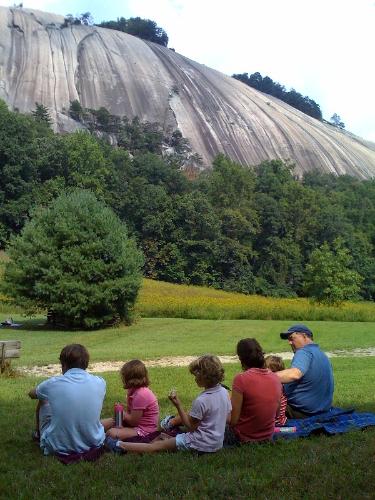
I cannot relinquish my heavy sorrow for Stuart’s  family, for his beautiful, gracious wife and the three precious young children and older son he leaves behind, pictured above with their sister and dad last summer at Stone Mountain — a massive granite outcropping in the shadow of the Blue Ridge mountains.  I don’t want to put down my own tender memories of summer weekends 30 years ago, when Stu would visit me at a camp overlooking this very same mountain.  I can’t stop singing the affirming, gentle refrain the congregation of 1000 mourners chanted repeatedly to set the tone for Emma’s memorial service — I can hear the brush of angel’s wings /  I see glory on each face / surely the presence of the Lord is in this place.

Like Mary Oliver, I am bent.  And I linger —  in waterfalls of memory, below mountains of grief, and yes, too, in startling laughter and in the warmth, joy and hugely generous love that will always be Stuart and Emma.

accumulating.loitering.skeins

•08/23/2011 • 3 Comments

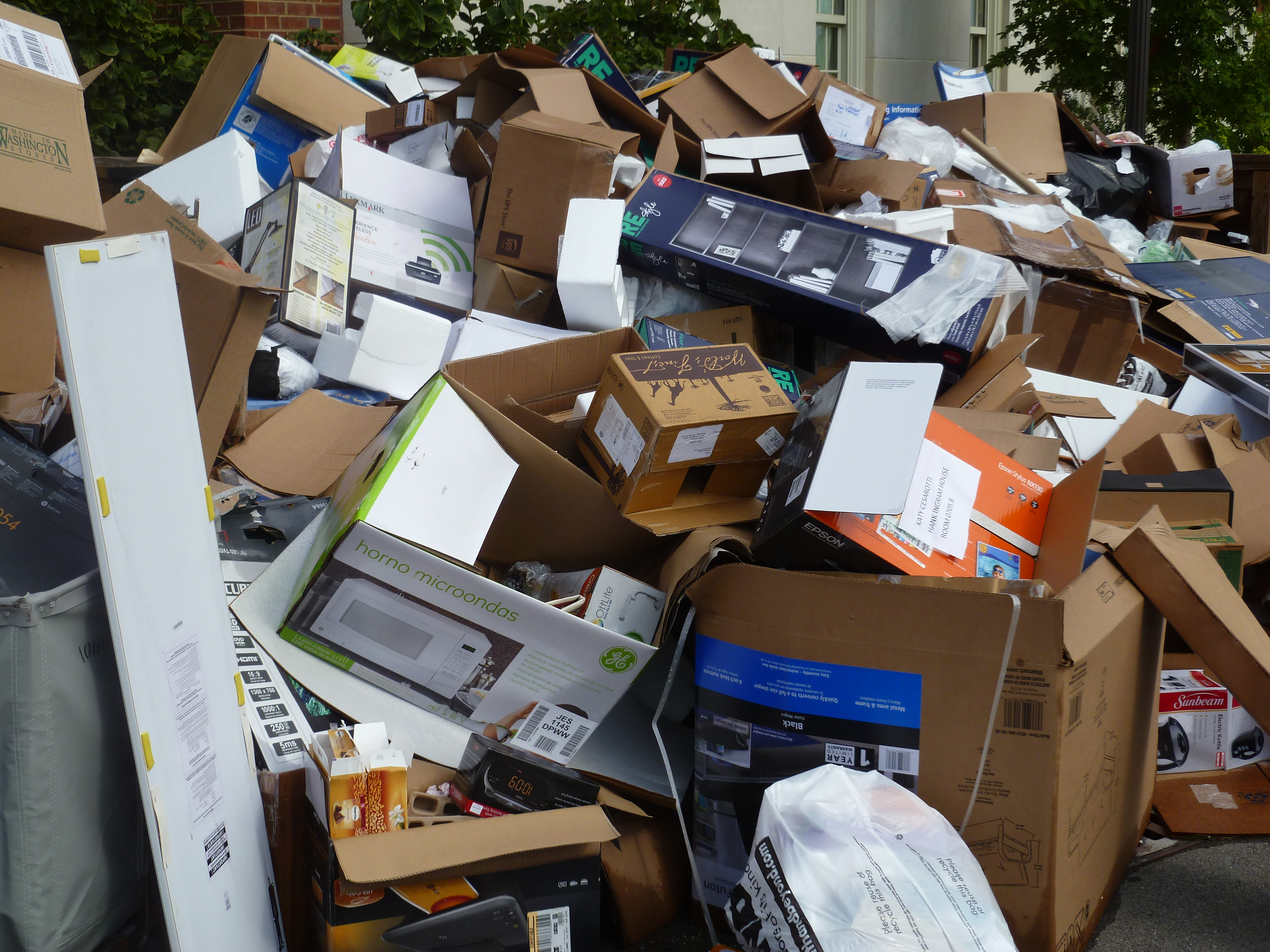
This was the scene on the backside of Ingram Hall on Vanderbilt campus Sunday morning, the day after Freshman move-in.

Cardboard carcasses. De-shelved shelves. Umpteen empty Target boxes. The privileged litter of eager students and well-stocked dorm rooms. A mind may be a terrible thing to waste, but so is a forest of packaging.

On the front side of the dorm, doors open to a manicured green quad, and beyond that biology and chemistry buildings, research labs, classrooms, libraries and their quiet, old-fashioned “stacks.”  A future to open and explore on one side; a pile of toss-aways on the other, and somewhere in between, my daughter deciding what she unpacks and leaves behind and what she takes with her. What will be recycled, reused, reclaimed as her own as she makes her way.

Before I got too bummed out, I spotted workers with box cutters tackling another nearby pyramid of entombed boxes, transforming them to a recyclable pile. There is hope.

And then I get home to this News Flash — hope indeed:

Northwestern University researchers said they found that the basis of ALS is a malfunctioning protein recycling system in the neurons of the brain and spinal cord. Efficient recycling of the protein building blocks in the neurons are critical for optimal functioning of the neurons. They become severely damaged when they can’t repair or maintain themselves.

Or as another report stated it:

In people with ALS, Feinberg researchers found ubiquilin2 isn’t doing its job. As a result, the damaged proteins and ubiquilin2 loiter and accumulate in the motor neurons in the spinal cord and cortical and hippocampal neurons in the brain. The protein accumulations resemble twisted skeins of yarn — characteristic of ALS — and cause the degeneration of the neurons.

Unrecycled accumulations. Twisted skeins of yarn. I think of Susan’s magical textiles woven from skeins of wool, spun silk, luminous linens. I think of theories, ideas, concepts, hypotheses, unsolved equations —  all loitering, waiting, to be discovered, embraced, untwisted, interwoven, in those university halls.

ALS is a recycling glitch? Pull out the box cutters; haul out the big blue bins. I have no idea what ubiquilin2 is, but I hope some body some where starts setting it straight.

anniversary. launches. sixty.

•08/08/2011 • 3 Comments

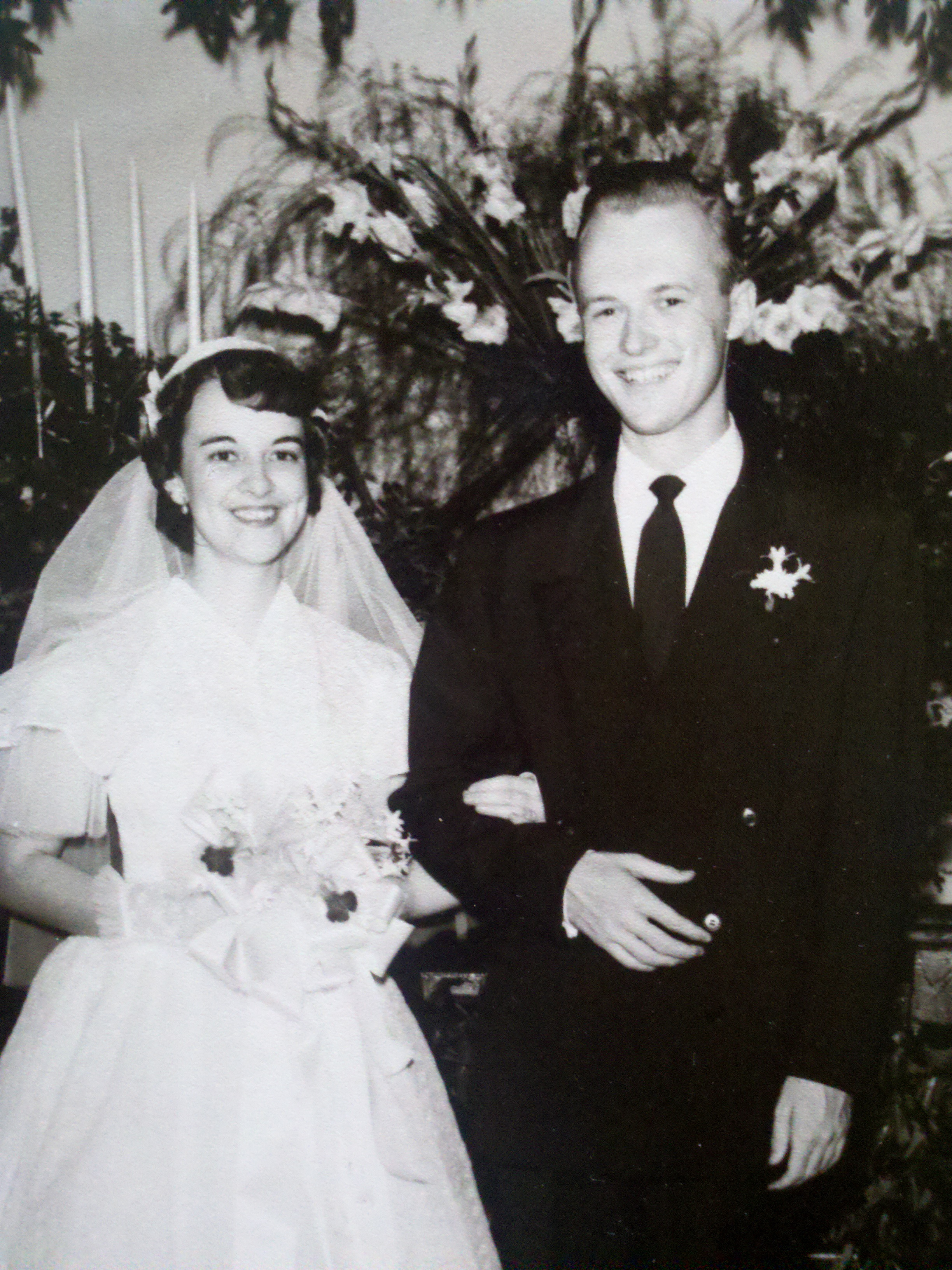
She reaches across the breakfast table and offers her hand.  Wrapped in a summery robe and a cap of fluffy new silver curls, she waits for his slow advance.  He inches his elbow toward her, leaning as he can to find the familiar embrace of fingers; then lights up to find them cupped around his own.  It is the morning of their 60th year.

She was a graduating college senior when, at Thanksgiving, he took her to his parent’s house in Birmingham. On the front porch swing of that unassuming bungalow, the two looked out on a long climbing road, one that meandered up out of dirt poor southern soil and twisted on above out of sight, holding possibilities they could not know.  The question quietly rose, and was answered.  Yes. Yes. They would take this road together.

Wedding proposals are getting so complicated, I read this week, that they are requiring proposal planners.  A woman casts her fishing line into the stream and comes up with a diamond that has been attached to the hook by professional divers under water.  Or buried in her molten chocolate cake by an accomplice chef.  But at 521 Broadway, there were no theatrics, not even any diamonds, save the one on my father’s mother’s hand, which she gave up to her son, so that he might make of it a ring for his new bride.  25 years later, for her own son, my mother quietly did the same.

I drive down Broadway last week, and pull over to take in the sloping lawn, the small porch that perches over it.  I spent my early holidays in this little house visiting grandparents, sleeping on the sofa that now anchors my living room.  I played on that old-fashioned porch swing, never knowing that it was where two lovers once took up a life.

Two blocks away, at the bottom of Broadway, I pick up GianMarco’s veal piccata, chevre torta, and fried green tomatoes for their 59th anniversary dinner.  I pull out their wedding china, with its striking singular rose, and cut my father’s meat.  I fetch the wedding album, and pour over pictures with Marilla, the caregiver who has joined us at the table.  A friend has made a fresh peach pie.

In the middle of dinner, my father grows intently quiet.  I see in his eyes the pain of spasms passing through him; they take over as they please, at any time.  My mother’s sight is so dimmed, she misses the  bread being passed to her.   For better or for worse, they are joined in one story – even as the broad road narrows at the top, even as it takes its sudden, frightening turns.  In sickness and in health, in a wheelchair and steadied by a cane, they yet do climb that long slow hill together.

When I see their two hands nestled like cups inside each other, I feel the living imperative: to love and to cherish.  They get up every morning, no matter how bleakly the day offers itself, and say yes to the love they chose sixty years ago.  At table, they lower their heads and give thanks for the gift in their hands, the one they have and hold.  It is what they have always done.  It is what they always will do.  Every uphill day. Till at death, they do part.

A.Life.Silent

•08/01/2011 • 5 Comments

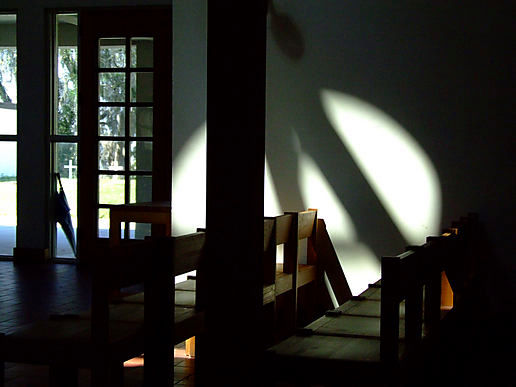
On these hard wooden chairs in the air conditioned oasis of Mepkin’s sanctuary, I took refuge from the 111 degree heat index and the blanket of silence that draped over the weekend, like auditory humidity, like shaggy Spanish moss, ubiquitous and moody. I woke at 5:15 to stumble in the still and warm dark to this spot, to listen to Psalms lifted up by gentle tenors. I returned at noon to listen again, more voices, more song, more prayer. And again for Vespers, then Compline, and in between, in the day’s long stretches of sunshine and heat and not enough breeze, there were no voices. No words. At meals the only conversation was the clinking of silverware on china, the screech of wooden chairs pulled in and out under the tables.  For two days, no one knew or said my name, no one asked me anything, or asked of me anything. There was only time, open and unspoken.

I am a lover and seeker of silence. In the car, I often turn off the radio. I do not open Pandora’s music box when on the computer. I mute the TV. My husband, on the other hand, will idle in the driveway for several minutes — even if we are running late — while he loads up his playlist. When he comes home for lunch, the first thing he does is turn on his mp3. While cooking dinner, it’s Miles Davis or Bill Evans.  My mother, too, craved noise.  She always had the TV or radio on. Always. When she went out to run an errand, she left the radio on for her cat — projecting her need for music and words on to her kitty.   I often worried what would happen if Mom’s ALS progressed to the point where she would come live with us — not because I feared the heavy-lifting of caretaking, but because I wasn’t sure if we could share the same sound environment and not go crazy.

In her last months, my time with mom was spent on high auditory alert. If I wasn’t right beside her, and even when I was, my ears were tuned in for the slightest sound of choking, for any noise that suggested she was trying to get up from a chair or reach for something.

As I soak in the luxuriousness of Mepkin Abbey’s cloistered quiet, I wonder if the inner dialogue gets louder, or lonely, after days and years of vowed voicelessness. And what it must have been like for my mother, and others, hushed not by holy vows but by helpless vocal chords.  I am haunted by her silenced voice. By what was left unsaid, unheard, what I should have listened for but did not, could not. By the sweet memory what I could hear: the tiny high-pitched squeal, barely a noise at all, that was her laugh. The labored puff of air forced through an unmovable jaw, the small, scared groan. The voices of Regis and Kelly in the background, the volume, always, turned up.


stephanie


Albuquerque. Los Alamos. Santa Fe.

•07/01/2011 • 11 Comments

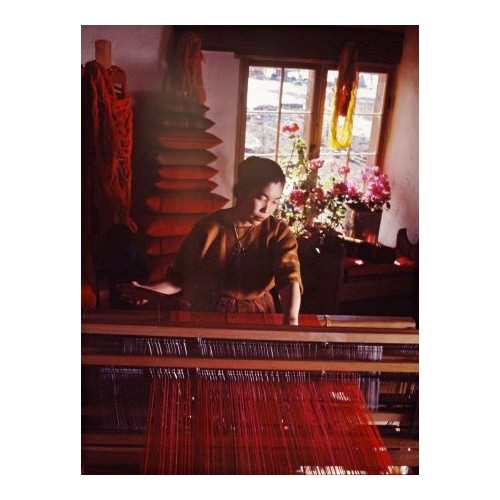
Japanese-American Weaver Alice Parrott of Santa Fe at Work in Her Studio Photographic Poster Print by Nina Leen

Just as I arrived in Santa Fe for a month of trade and inspiration, an uncontrollable wildfire burst out twelve miles from here in Los Alamos, birthplace of the nuclear bomb. This small city quivers under menacing skies.  Air quality levels are tested daily for radioactivity.  My friends have packed boxes of their precious things, poised to flee.  Through my kitchen window one evening, I watched a round red ball of sun descend behind an apocalypse of smoke.  I couldn’t help but scramble to the roof, trying to believe my eyes – it was that ominous, that beautiful, totally unnerving.

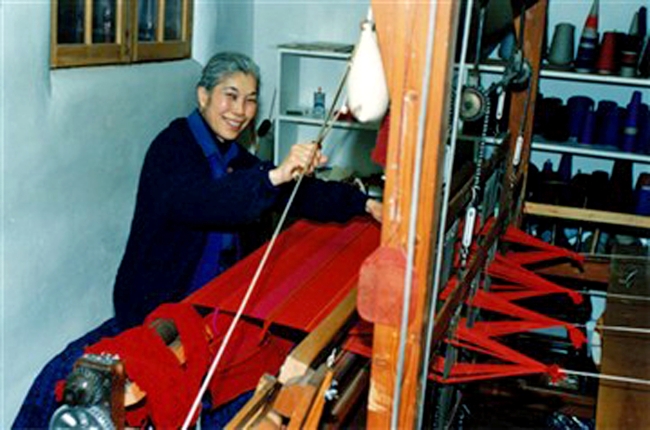
The next morning, out on a run, I follow paper bag signs to an estate sale, where a gentle man oversees the dispersion of his aunt’s remaining baskets, a coat rack, TVs, a crate of LPs.  In the back room of this small adobe house on Canyon Road, boxes of textile remnants flash with color.  I kneel and dig, finding treasures of rolled indigo kimono cloth, Guatemalan handwoven stripes, a box of feathers plucked from the land.  The lingering presence of this unknown woman, who drew beautiful, humble, hand-made things to her, fills the room.  Alice Kagawa Parrott was a weaver, I learn from her nephew, of some renown, with her works in museum collections in Europe and the US.  I had no idea. He showed me her weaving studio, nestled in the dust of one of America’s most visited art avenues; four looms, some still warped, surrounded by a chorus of her vegetable-dyed yarns on shelves, now silent.

Listening online to her oral history interview with the Smithsonian, I learn that Alice’s Japanese parents, from Hiroshima, immigrated to Honolulu.  Her mother worked as a packer in the pineapple plant, her father as carpenter on the railroad, in order to send their daughter to the University and on to elite Cranbrook Art Academy.

Alice settled in Santa Fe in 1956, in the shadow of the bomb that just eleven years earlier annihilated her parent’s home, killed her aunt, left her cousin mentally ill.  She spent a lifetime here, carding fiber, spinning wool, dyeing from local roots, weaving connections.  She taught her craft, sold storefront what she loved, cooked up large dinners for friends.  She married and adopted two Navajo boys.  She won grants and traveled to India, to Guatemala, to the great cultures of cloth, and brought home handwoven treasures, which sit right now in a pile on my desk, beside me.

How can I explain my feet turning up Canyon Road, following paper bag signs, drawn to an empty adobe meeting house?  How could I have known this woman would leave me remnants of her imaginative life, her daily, intimate courage spinning life under the shadow of death, creating kindness, cooking up beauty?  How do you know when you may inherit a  box of precious things, after life has fled away, and want to make something new of them?  That serendipity is the surprise of life meeting you under the shadow of clouds?

Even with the detonating illness mushrooming in my father’s body, day after day, in the midst of it, he gathers loose threads, makes connections, weaves with words.  He radiates generosity, he counts the blessings of the day, shines like the red sun behind the clouds.  Sometimes, the illness is ominous; sometimes what it has made of him is beautiful; often, the whole business is unnerving.

Great clouds of unknowing hover over us everywhere. We are in the throws of a great climatic shiver: floods, tornadoes, droughts, tsunamis that leave us shaken, stirred, awake.  I pick up some of Alice’s threads, some of my father’s words; I braid them together.  This is the work they have given me, work that I will carry on.  Making connections.  Bearing the shadow.  And creating, I hope, red and fearless as the sun.

Alice Kagawa Parrott, 1929-2009

after.life.savings. (are gone)

•06/16/2011 • 4 Comments

Before you know what kindness is,

you must lose things,

feel the future dissolve in a moment

like salt in a weakened broth. . .

I’ve opened a new book by Geneen Roth about losing what we think is important; in the case of the author, it was losing thirty years of her family’s entire life savings to Bernie Madoff.  With the post-call phone still in her hand, she stood motionless in her kitchen for a long time, swirling into a tempest of catastrophe, until at last, out of the center of it rose the memory of this poem.  The kindness poem, as she calls it,  by Naomi Shihab Nye.  After what seemed like hours of paralysis, she could move her legs again – she suddenly had to find the poem and let herself down into its rhythmic depths.

Before you know kindness as the deepest thing inside,

you must know sorrow as the other deepest thing.

You must wake up with sorrow.

You must speak to it till your voice

Catches the thread of all sorrows

and you see the size of the cloth. . . 

I know that I have a lifetime of sorrows lying about on the floor like loose threads in my unkempt work room.  We all have snipped and clipped from our more perfect lives and left our sadnesses like scraps beneath us, stepping all over them with our dusty shoes.

But when I wake up to sorrow – even one pure sorrow – I am emptied of airy ambitions, I am lowered to the scrappy floor.  I speak softly into the aching places, until my voice, in a tremor of kindness, catches the threads of all sorrows and I see the startling size of the cloth.  Wide as a carpet, woven, unfurling; wide as all the world standing upon it, for surely our sorrows, in the end, are one.

Then it is only kindness that makes sense anymore,

only kindness that ties your shoes

and sends you out into the day to mail

letters and purchase bread

only kindness that raises its head from the crowd of the world to say

it is I you have been looking for,

and then goes with you everywhere

like a shadow or a friend.

to read or hear “Kindness” by Naomi Shihab Nye in its full length, go to http://writersalmanac.publicradio.org/index.php?date=2007/07/23