Along.Limantour.Shore

•03/15/2011 • 4 Comments

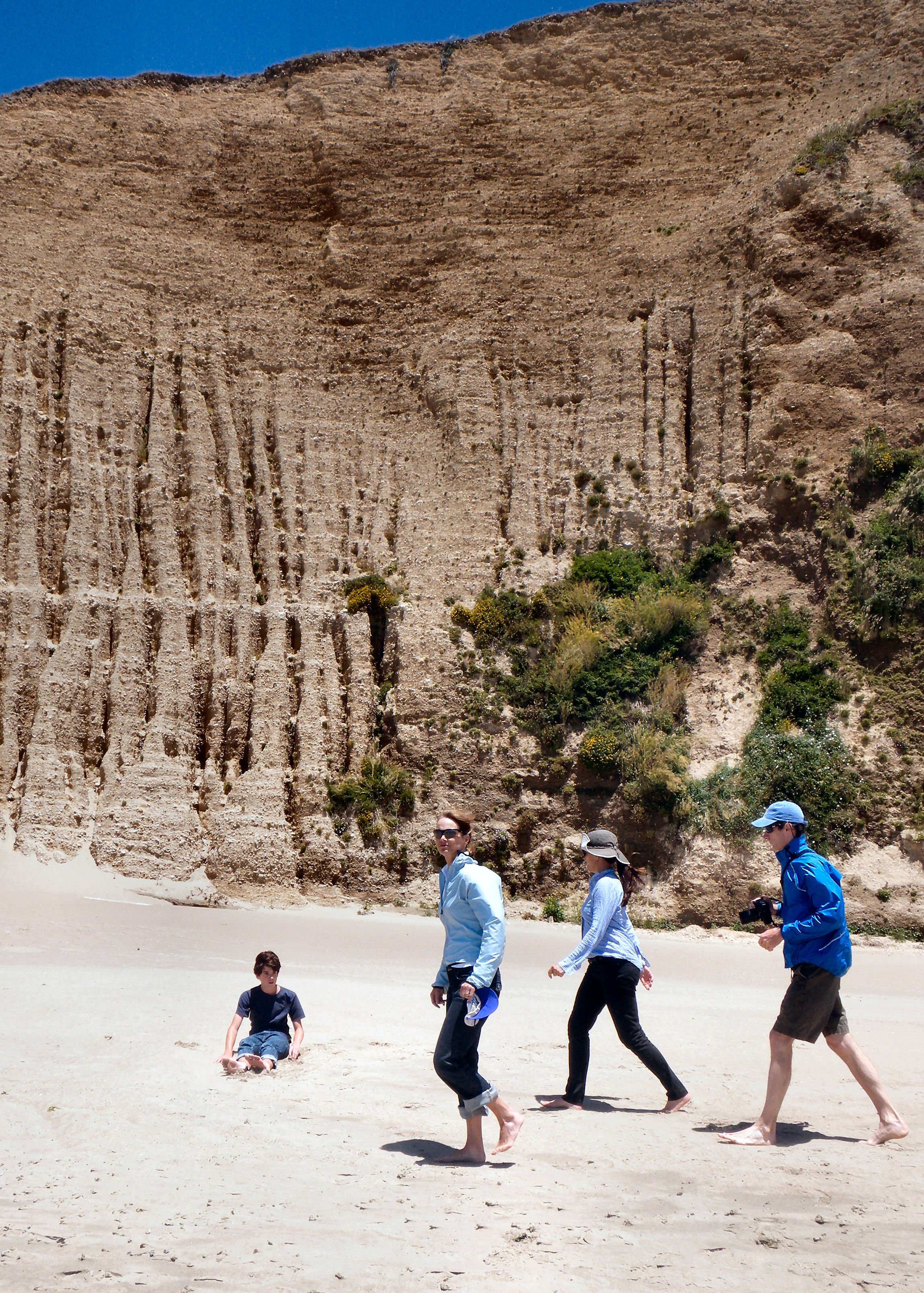
The wind off the Farallones has carved these cliffs into a massive Georgia O’Keefe sculpture. We walk for miles beneath their steep shoulder, taking the wind at full brace, grateful for Gortex and nylon and the sturdy company of old friends. Patrick and Maria are our pals from 20 years ago in Cambridge, back when Noel and Patrick were in residency, back before either of us had children or mortgages or aging parents. Two decades later and two coasts apart, we pick up where we left off on a visit to see them last July in Point Reyes, California. We ramble for long hikes in eucalyptus-scented forests, while away an afternoon on a blustery jaunt down Limantour Beach, only now the trail of conversation leads from organizing school auctions to moderating teen moodiness to Maria’s painting and my writing, then back again to parenting — to our parents.

We’re astounded by the similarities — both Maria’s father and mine have Alzheimer’s; both of us watch their accomplished lives erode, like these weathered cliffs, into a craggy confusion. We share concerns about the care they receive and struggle with complex relationships with our father’s spouses. We walk in step, in silence, watching as gulls and peregrines kite overhead, our answer-less questions soaring  and circling with them.
A month and a half after returning from our Pacific sojourn, my dad has died. An email from Maria last week tells me her father passed away in February. Long hikes come to an end. She writes, you know what it’s like to lose someone twice, especially with mixed feelings.

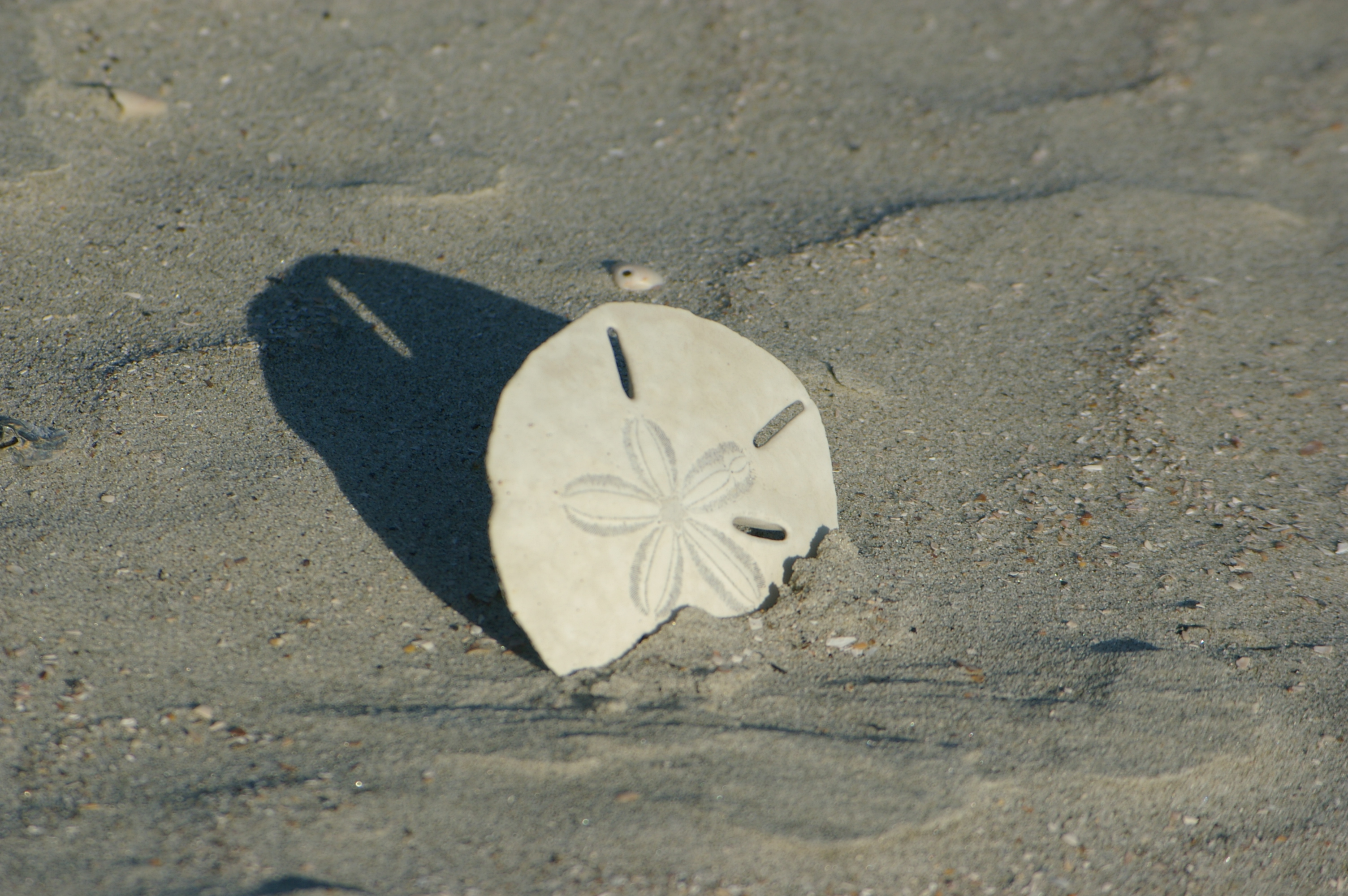
This past weekend Noel and I stole away to Dewees Island, an island idyll just 20 minutes from our house, but it’s our first time alone and away since that magical California trek last summer. We putter along empty beaches for miles and miles, reconnect with the old friend that is silence, and each other. Noel studies driftwood; I gather shells. Loads of them —  fragile foreclosed homes of whelks and sea snails,  spent sand dollars, the emptied envelope of the lettered olive. I trace my fingers along their broken spirals, place their abandoned loveliness in my pockets. Carry them gingerly, so the still-connected pearly-gray angel wings don’t break apart.

a.last.sough.

•03/07/2011 • 6 Comments

Where have you been? ask my friends who haven’t seen me out on the usual social runways in recent months.  And I want to say, I’ve been in the family way, meaning I’m in the business of family ministrations; but then I remember the words usually mean barefoot and pregnant, which, in my ripe middle years, I certainly am not.  I lay those words down.  Oh, just busy with lots of things.

And then I pick them up again.  Okay, not with child.  But something akin to it.  There is a great symmetry between birth and death, of course.  A woman in the family way spends months pulsing in wait.  Tending, loving, emotionally nursing; utterly out of control of what is happening.  The life within comes with its own timing, comes when it will. What is needed is attention and strength, tenderness, and patience without will.

And so it is to tend the dying.

Early Saturday morning, I received the summons to the home of my father-in-law.  I  dressed quickly, grabbed a couple of bananas and a clean T-shirt and headed out to hunt down my husband, threading the Charleston streets on his morning run.  Sitting with Lawrence, surrounded by his family, we listened to his labored breathing (yes, labored, as a woman labors in the last hours before birth).  We touched what remained of his flesh, stretched over the honest architecture of bone, eyes distant, pulse receding like the tide.

We waited.  We browsed through family photo albums and I marveled at my husband in tiny incarnations.  We sat in the cradle of the afternoon, and pillowed his silence with our familiar voices.  And in that gentle rock of time and conversation, he took a breath so quiet, we hardly knew it was his last.

A baby’s first job is the hungry suck of air.  And our last job is the flutter and gasp of letting it out. I don’t know which is harder, though they both require lungs full of courage, and, no matter how you see it, faith.  At ninety-five, Lawrence had taken in enough of all that is good, and he had loved it; and then he had the courage to let it go.  In one last sough we hardly heard.  He returned to where he had started, but this time, blanketed by the presence of those he had fathered and loved.

I have never been a mother, delivered a child, held the flesh of my flesh.  But now, I am in the family way, nonetheless.  I am tending the going out of those before me, holding their hands, as I can, while they step backwards toward dependence, as they return toward  stillness; as they summon courage for breathing out.  It is another way of carrying life.  I am content to dwell at the threshold with those I love, finding the pulse in relinquishment.  Because I want, in this life, to  be present for everything:  the circle, the fullness, the emptying, the return.

Lawrence Adams Walker
January 16, 1916 – March 5, 2011


(not on) a.library.shelf.

•03/03/2011 • Leave a Comment

Peter Gomes died Tuesday, at 68, a demiurge of American religion.  For 41 years a minister to Harvard University, intellectually robust, socially august, a parade of pomp and personality, a drum roll for love and tolerance, Gomes authored a most uncommon life.  He called himself black, gay, and Republican; a high church liturgist, a rogue Baptist preacher, a Catholic at heart. He wore an aristocratic mantle, lived liberally, thought conservatively, enjoyed a considered and thoughtful decadence.  He was a voice for the pilgrims of Plymouth, from which he hailed, as much as the slaves from which he descended.  Peter was my advisor at Harvard; Stephanie served a committee under his charge.  We both agree he was a force, like wind; your tidy little stereotypes quickly undone by his velocity.

The Boston Globe, posting news of his death, mentions that Peter planned to retire in a year and a half, at 70, and write his memoir.  This sounds achingly familiar, as my father for thirty years harbored the same desire; months away from beginning his memoir, his diagnosis came hammering down.  A section in his library is devoted to volumes collected over many years toward this project:  titles about the cities of the South where he was formed, the culture he inhabited, the battles he found worthy to engage, the ground he stood upon and how it shook.  It saddened him that he would not have his later years to pitch his energies toward the task of interpreting his life in the narrative of his time.

Peter Gomes, likewise, surely could have filled a book with stories as colorful as his tenure in purple vestments.  Many will remember the power of his pride and his humility when he walked out onto the steps of his Memorial Church in the face of strident and hateful opposition and said aloud and for the first time:  I am a Christian who happens as well to be gay … Those realities, which are unreconcilable to some, are reconciled in me by a loving God.

We are always, in every moment, writing the narrative of our lives in the idiom of  everyday, taking our stand upon the shifting ground beneath us, speaking our selves  into this moment, as fearlessly as we can.  Death’s intimate presence these days reminds me that we are not always allowed a final gathering up, a conclusive chapter.  What we write is now.

Thousands will come together recalling the moments we brushed against Peter’s candor, fell to his humor, his centrifugal force.  We will gather together like words on a page, tell stories of over-the-top dinners at the Sparks house, lavish in love and hospitality, or a personal warmth received at one of his celebrated tea parties.  (It picks you up at the flabby part of the day, he said of his tea and silver service.)  Our disparate lives will begin to compose a memoir, of sorts. Perhaps I will stop apologizing for my decadent bent, and learn to squander it on others.  Or stand on the steps of my own truth and say outloud, with pride and humility, what I know to be true, though others protest. Perhaps, I will become more prodigal, and odd.

Thanks be, thanks be, I want to say, for the authors of these two articulated lives. Their gift to me is not a book on the shelf, a memoir of burnished memory, the crafted word.  It is a force, rising on the wind.

Audible.Little.Snail

•02/28/2011 • 2 Comments

Claire, sporting a baby praying mantis (in lieu of a snail)

“There is a certain depth of illness that is piercing in its isolation; the only rule of existence is uncertainty, and the only movement is the passage of time. Once cannot bear to live through another loss of function, and sometimes friends and family cannot bear to watch. An unspoken, unbridgeable divide may widen. Even if you are still who you were, you cannot actually fully be who you are.”   from The Sound of a Wild Snail Eating, by Elizabeth Tova Bailey

I’ve been savoring Elizabeth Tova Bailey’s lovely little book, an extended reflection on succumbing to paralyzing illness and the saving grace of paying attention — in Tova’s case, paying attention to a tiny snail that hitchhiked in on some field violets a friend brought in. The book is part biology project, i.e. Everything You Always Wanted to Know about Gastropods (snail sex; the many uses of mucous, dietary habits of slugs), and part poetry, as the author draws subtle parallels between her existence, slowed by a mysterious mitochondrial virus, and that of her snail companion. But mostly it’s a meditation on bridging divides. On finding connection in surprising places — in a tiny bedside terrarium, in ancient 4th century texts on animals, in watching the minuscule life of a snail unfold in exquisitely detailed richness.

This divide she speaks of is real. A distance grows as my mother continues to lose strength and ability, yet continues, with equal fortitude, to refuse assistance. There’s a silent gulf between my rational sense of safety and responsibility and her emotional need for control, and anger and frustration trickles in to that space between. Before bed, I read of Tova and her snail, seeking wisdom in her gentle observations and pleasure in her lovely writing. And finding nuggets, like this epigraph she uses to introduce Part 2 of her book:

Think not of the amount to be accomplished,
the difficulties to be overcome, or the end to be attained,
but set earnestly at the little task at your elbow, letting
that be sufficient for the day.
~~Sir William Osler, physician (1849 – 1919)


Stephanie

A.Legacy.(of)Shannons.

•02/21/2011 • 4 Comments
Hulls and Shannons in Andrew’s stairwell

. . . he makes me lie down in green pastures,
leads me beside still waters,
restores my soul . . .

For thirty years, Jane sits with me at the family table, spreads the Thanksgiving feast, washes dishes by my side.  My brother’s wife; the sister I did not have, but blessedly drew in the lot of marriage.  Last week, Jane’s father went down with a stroke.

. . . through the valley of the shadow of death,
I fear no evil . . .

In a church pew in Winston-Salem, I sit behind Jane as she holds her mother’s arm.  My nephew, Andrew, who cares daily for my father,  stands before them.  He pours out an ointment of words over his mother, his grandmother.  The twenty-third psalm lifts with his voice and fills the sun-warmed room, ringing for his other grandfather.

. . . you prepare a table before me.
My cup overflows. . .

Mary has lost her partner of sixty-eight years.  After the service, she takes us into her home, offers drinks and refreshment, settles into the afternoon.  At almost ninety, she is strong, and wondering what is possibly next.  Surrounded by her children and grandchildren and a few others like us, it is as though she savors a banquet spread before her.  She sits in the midst of it, her cup emptied, and yet running over.

. . . surely goodness and mercy shall follow me all the days of my life.
and I shall dwell in the house of the lord, forever.

As the sun sets, my husband and I melt into the long ribbon of road heading home.  I  hear my niece’s soprano voice soar over her grandfather’s casket, rattling the church windows, shattering the last panes still hanging in my opened-up heart.  I didn’t have to spend a lifetime with Bruce Shannon to know that goodness and mercy follow him.  I only have to hear the voices of his grandchildren rippling with praise; bright with love and honor.  How they fill the house he built for them, the house where love dwells, forever and ever.

Amen.


attending.Lahiri’s.subtlety.

•02/13/2011 • 1 Comment


No, I didn’t always want to be a writer, Jhumpa Lahiri begins her keynote address, answering the question everyone loves to ask.  Her dark hair pulled back exposes a tense, serious brow; dark eyes dart from manuscript into bright lights, glinting toward an audience of hundreds, and quickly, like a bird, repair to the shelter of her written words.  In quiet, measured sentences, contained and subtle as her stories, she tells her own.

She didn’t want to be a writer, but wrote nonetheless, as a girl, noticing the quiet spaces in her family where loneliness slipped in.  She overheard the complicated conversation of curry and cardamon in her mother’s Rhode Island kitchen.  She sensed shadows passing across her parent’s faces, learned the polite cadence of emptiness, studied the photographs of family in India, feeling their breath upon her.

She didn’t write to be a writer; but to notice the weight of life that went unnoticed and so put it down, call it out, make it real.  She names the colors that pass between people like an expert dyer might name the subtle palette of an Oushak carpet – so faint, one could walk over it and call it merely yellow; while she sees young forests and mold and sun over the sands.

Lahiri is a lyricist born under a pragmatist’s roof.  Even after the Pulitzer Prize, the Pen/Hemingway award, a Guggenheim Fellowship, her parent’s warned:  You cannot count on writing to support you.

And yet, it is the only thing we can count on:  doing what we are called out of line to do, no matter who understands its meandering direction, or not.  Picking up the tool – the pen, the needle, the paintbrush, the trowel – that shreds the membranes of who you thought you were going to be,  so that you might begin to notice who you are.  To begin to notice, as Lahiri shows me, how my animal body tracks its silent appetites, where my eye turns, drinking in light; when my heart contracts, and to what beauty exactly, it chooses to open.

I sit on the third row, watching her face gleam under the harsh lights, listening to this quiet soul unspool her story.  This is where noticing takes you, I see, if you will bother with the truth under the tea cups.  To a place of saying out loud as simply and clearly as you can, where others yearn to hear, just what it is about this unaccustomed earth that you have found to be real, and therefore, unutterably dear.

Susan
2-13-2011

Ardent.Lyrical.Spirits

•02/06/2011 • 2 Comments


1955. The leafy perfume of tobacco hung on Durham’s dark night air. It was after midnight, and Reynolds Price had taken it upon himself to pick up Ms. Welty, who was coming to give a lecture at Duke Women’s College.  The lecture two days later would be titled “Place in Fiction” — but that night at the train station, Price did not yet have a place in fiction. He was a Duke senior with one scrappy short story to his name, an inkling for narrative, and a crush on Ms. Welty — a literary crush. I’m sure his heart rate spiked and his palms grew sweaty as she stepped down off the train in those clunky mary-janes she wore. During her three day visit to Duke, she generously agreed to read his story, then asked if she could share it with her agent. “Could she?” Price loved to say when retelling this story, his honed- marble voice steeped in delight and gratitude.

Fifty-six years later, Price has written more than 30 books — novels, short stories, plays, essays, Gospels and memoir, including his last, Ardent Spirits: Leaving Home, Coming Back. His death two weeks ago has sent me to my bookshelves, reading through his short stories, revisiting Kate Vaiden, tasting his wisdom in the NPR-aired commentaries collected in Feasting the Heart. As a student at Duke, I spent hours in the library’s Rare Book Room reading Price’s papers, pondering elegant handwritten margin notes on his manuscripts, looking for clues on how the mind of a writer works, how the magic happens. I never had the nerve to take his classes, but only idolized him from afar, part literary crush, part lionized father-figure (he and my father were classmates at Duke, my dad the dashing football player and fraternity boy, he the debonair writing student and Rhodes Scholar. Despite my dad’s claims, I doubt they really knew each other). Only once at a literature conference years later, did I muster the nerve to go up to him, express my admiration and introduce myself, my voice shaky, my palms damp.

In Ardent Spirits and elsewhere, Price shares that his motto is: “I’ll only regret my economies.”  He lived a splurged life. He spent his artistic gift and said “keep the change.” He indulged in friendship, in teaching, in renegade faith, in beauty, in pain. He inhabited his wheelchair like a throne and wore scarves around his neck like a clerical stole. His voice was deep and resonant, his stories dense, his turn-of-phrase poetic, heavy and occasionally pretentious, his classroom reputation intimidating, his gentle and frequent smile was knowing and broad.

I regret many economies — including the chintzy ego that shied away from his class. As a student still, however, I intend to learn from his fiction and his life. My latest discovery: that Price was perhaps the first significant American novelist to have a top 40 pop hit. Yes, my literary crush co-wrote two songs with my musical love — James Taylor : the top 40 “Copperline” and the lesser known, New Hymn.  Listen to two of North Carolina’s most beautiful, lyrical voices.


A.Ludicrous.Shadow

•02/03/2011 • 3 Comments


I’ve never been able to figure out Groundhog Day — it seems counter intuitive to me that if furry ol’ Phil does NOT see his shadow, then an early spring is coming to the rescue.  Shouldn’t it be the other way around? He sees his shadow if the sun is out; the sun heralds brighter, warmer days ahead, ergo, shadow should be good news. But that’s not how it, allegedly, works. And besides, I no longer trust prognostication anyway.

The week before Christmas nurses and doctors told us my mother had maybe a few weeks, perhaps a month. Going on 2 months later, it all feels like sweet bonus time.  This disease is so damn hard to predict, but the shadow is unmistakably there. It hangs heavier each day, as does her head, now that neck muscles have surrendered, retreating back into a long winter sleep. And the shadow of this failing body casts other darkness — frustration, fear, short tempers, unspoken wishes, heavy and gray silence. We fumble around in the uncertain light, the tripping shadows, as best we can.

I don’t know how, exactly, the days ahead will unfold.  I no longer look to timelines or predictions.   But I know that winter and weakness will linger, and warmth and sunshine will come, blessedly, at intermittent times, to show us the way forward.  I know that shadows are inevitable, and necessary, and that seeing my own offers an opening toward spring’s promise of growth.


Aperture.Lens.Shutter

•01/20/2011 • 1 Comment

In the spring of 1992 I indulged my inner Annie Leibovitz and took a Basic Photography class at the Cambridge Center for Adult Education — tucked in an old house with warped floors in the middle of Harvard Square. We learned the old-fashioned pre-digital ins and outs of f-stops and depth of field. We talked shutter speeds and film types, and practiced the mysterious alchemy of the dark room — dipping paper in chemical baths until, voila, a grainy black and white image appeared. I wandered solo on photo safaris to Mt. Auburn Cemetery and in Harvard Yard, hoping to look more artist than tourist as I focused my lens.  It was a brief love affair, me and my camera in our quiet, dark room. Since then, I’ve abdicated most family photo ops to Noel, whose eye is quirkier than mine, and who knows how to charge the camera batteries and download pics to the computer  — new fangled technicalities I’d rather not bother with.

Around Christmas a friend gave Noel her father’s old cameras — a lovely leather-encased Kodak Retina IIIc — a 1955-era German-made marvel, and an early Canon A-1, a trusty SLR hyped at the time as “the first camera in the world in which all information, both input and output, is in pulse signals”, i.e. digital. They are collectors’ items, relics of another era. For Christmas, Noel gave me a tiny pocket-sized Panasonic Lumix, so I can point and shoot to my heart’s desire, especially for blog photos. I love the juxtaposition of our camera acquisitions: his — the classic, hefty, manual machines that required knowledge, intention, patience and skill; and mine — the modern, mindless, quick and easy. And I particularly love imagining what the owner of these old cameras looked for, and saw, through his lens. The moments he tried to capture. The beauty he beheld, the memories engraved by light on film.

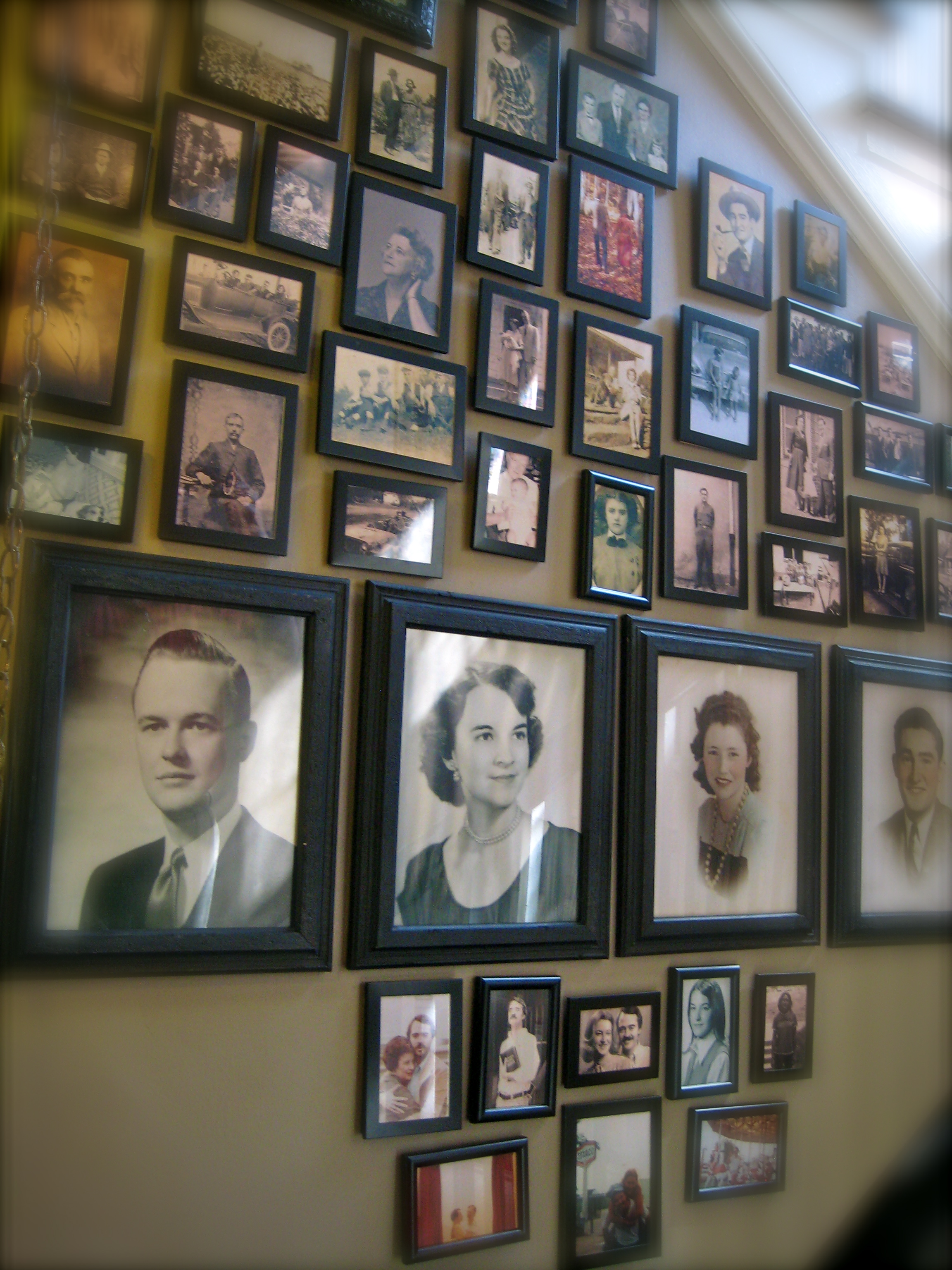
On my frequent trips to mom’s house, we dig through old photos, piecing together family history and fashion trends through curvy-edged sepia images. My cousin Sara recently brought over a new trove to cull through, including one of my grandmother on the beach in her bra.  Memory lane is rich and lovely, and I’m thankful for each point and click, each squint of eye and winding of film, that delivered those singular moment in those years, years ago, to me now.  Stories, glimpses, expressions, exposures.

I travel lightly with my fully automated snazzy new Lumix. What will I focus on? What apertures dare I open? How much light will I let in, and for how long?

a.long.settlement (project).

•01/08/2011 • 2 Comments

And how I will cherish you then, you nights
of grieving, sisters I couldn’t console.
How I wish I had gone on my knees more freely,
surrendered myself more loosely to your loosened hair.
Sorrows — how we waste them! How we keep looking ahead
at their sad length, to see if maybe they’ll end.
When really they’re nothing more than our winter foliage,
our dark evergreen, just one of the seasons
of our hidden year — and not only season,
but setting, settlement, campground, the place we live.


Rainer Maria Rilke,  Duino Elegies, #10
trans. by Gary Miranda

It has taken me a lifetime to settle down into my sorrows, to pitch my tent in this campground where the human family lives.  I’ve turned instead toward ambition or love, built a house of happiness on higher ground.

Yet, all the while, if we are to believe Rilke, our sorrows lie below, a dark and fertile season to also hold us. And not just that – they are the place where, together, we all live as one.  Of course, moments rise into the light, shimmer in a dazzling grace.  April flourishes, yes! Joy bounds out of secret places.  But he is right to hold our feet to this common ground.  I find, at last, it is freeing to take up residence in this wintry season.  I do not want to waste any portion of my life, no matter how it is given.  Especially not the nights of grieving.  They are sisters to my joy.

When I live in this camp, my breath deepens.  My senses waken.  Mystery I cannot name enters in.  I don’t need to console my sorrows, or manage them, or turn away from their tender faces. I simply want to bear them, like evergreen boughs bear the snow.